As an Amazon Associate, we earn from qualifying purchases. Some links on this site are affiliate links at no extra cost to you. Our recommendations are based on thorough research and editorial judgment.

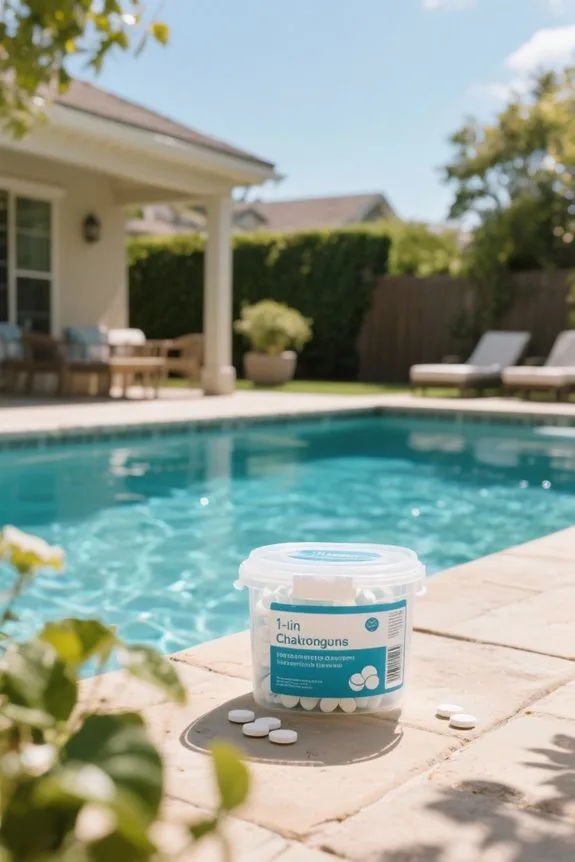
10 Best 1-Inch Chlorine Tablets of 2026 — Keep Your Pool Sparkling and Balanced

Choose Clorox XtraBlue, HTH, ClearView, In The Swim, and XtremeClear tablets, dose one 1-inch tablet per 5,000 gallons in a floater or inline feeder. Test free chlorine with DPD strips, aim for 1.0 to 3.0 ppm, adjust floater or feeder to prevent caking, clean feeder monthly with a soft brush, avoid contact with metals or acids to prevent corrosion. Follow label storage at 50 to 77°F, continue for full product comparisons ahead, plus tips.
Key Takeaways
- Choose tablets from reputable brands (Clorox, HTH, ClearView, In The Swim, Rx Clear) for consistent sanitation and proven formulations.
- Match tablet type to pool size and dispenser: slow-dissolving for floaters/feeders, concentrated for large in-ground pools, calibrated for spas.
- Aim for 1.0–3.0 ppm free chlorine; follow label dosing (often 1 tablet per ~5,000 gallons) and retest after dosing.
- Monitor cyanuric acid (stabilizer) buildup with stabilized tablets and avoid overuse in salt or indoor pools.
- Store tablets dry, cool, locked and separate from acids; always use gloves, goggles, and tongs when handling.
Clorox Pool & Spa XtraBlue 1″ Chlorinating Tablets (5 LB)

Clorox® Pool&Spa™ XtraBlue 1” Swimming Pool Chlorinating Tablets, Kills Bacteria & Stops Algae...
- Cleans Water & Stops Algae: Kills harmful bacteria and prevents equipment corrosion, scale and stains. Kills and prevents all types of swimming pool algae (green...
- Long-lasting sunlight protection: Contains chlorine stabilizer to extend the life of your clean
- Creates Silky Smooth Feeling Water: XTRABLUE chlorinating tablets contain conditioners for silky smooth feeling water

You may be interested

Choose this option if you need stabilized, long-lasting chlorine that prevents algae and protects equipment in larger pools. Handle 1″ tablets in a dry area. Place tablets in a floating dispenser, automatic feeder, or in-line chlorinator sized for 5 LB supply, adjust flow. Use test strips and the Clorox Pool App. Target free chlorine 1.0 to 3.0 ppm, troubleshoot cloudy water by shocking, backwashing, and confirming stabilizer levels. Avoid tablet contact with metal and vinyl. If you detect scaling or corrosion, lower tablet feed, test pH and alkalinity, and service equipment within 48 hours. Consult label for safety precautions.
Best For: Pool owners with larger, outdoor pools who want stabilized, long-lasting chlorine that prevents algae and protects equipment.
Pros:
- Provides stabilized chlorine that lasts in sunlight and helps prevent all types of pool algae.
- Kills harmful bacteria and includes conditioners for a silky-smooth feel.
- Safe for vinyl, plaster, fiberglass, and tile and helps protect equipment from corrosion and scale when used properly.
Cons:
- 1″ tablets require a floating dispenser, automatic feeder, or in-line chlorinator and proper handling to avoid damage.
- Direct tablet contact with metal or vinyl can cause staining or damage if not avoided.
- Improper feed rate can contribute to scaling or corrosion and requires regular testing and possible servicing.
HTH Pool Care 1″ Chlorine Tabs (5 lb)

HTH 42047 Pool Care 1" Chlorine Tabs, Swimming Pool Sanitizer with Added Clarifier - Eliminates...
- BENEFIT: Protect your swimming pool and enjoy clean, clear water with these easy-to-use chlorine-based tabs; Kills algae and bacteria
- CLEAN, CLEAR WATER: HTH Chlorine Tabs keep water clear while protecting against bacteria, algae and other organisms
- SLOW DISSOLVING, LONG LASTING: Sun protected for longer chlorine life, HTH Chlorine Tabs dissolve slowly and last up to one week
Use HTH 42047 when you need a slow-dissolving, long-lasting sanitizer for routine pool maintenance. Add tablets to a floater, feeder, or skimmer basket. Dose one tablet for above-ground pools, three tablets for inground pools, monitor output. Test water twice weekly with HTH 6-Way Test Strips. Maintain free chlorine between 1 and 4 ppm, adjust floater openings or feed rate when levels stray. Expect slow dissolution, tablets may last up to one week. Use clarifier to improve clarity, run pump 8 to 12 hours daily, clean filters if turbidity persists. If using salt systems, verify compatibility and monitor stabilizer levels.
Best For: Homeowners or pool operators seeking a slow-dissolving, long-lasting sanitizer for routine maintenance of above-ground or inground pools.
Pros:
- Provides long-lasting sanitation with slow-dissolving tablets that can last up to a week.
- Compatible with all pool types (including saltwater systems) and usable in floaters, feeders, or skimmer baskets.
- Contains an added clarifier to help improve water clarity when used with proper filtration.
Cons:
- Slow dissolution makes rapid chlorine adjustments difficult if levels suddenly drop.
- Requires regular monitoring (twice weekly testing) and adjustment of floater/feeder settings to maintain 1–4 ppm.
- May need extended pump run time (8–12 hours/day) and filter cleaning if turbidity persists.
ClearView 1-inch Chlorine Tablets for Swimming Pools and Hot Tubs (10 lb)
Determine if you maintain a small-to-medium pool or spa, since this 10 lb ClearView bucket delivers concentrated, slow-dissolving 1-inch tablets. Measure your volume, add one tablet per 1,000 gallons, use a floater, feeder, or skimmer basket. Expect tablets to dissolve slowly, lasting up to one week due to the stabilizer and sun protection. Note each tablet weighs 0.7 ounces, bucket holds 225 tablets, diameter 1.25 inches, check dispenser fit. Use with vinyl-lined or saltwater systems, monitor free chlorine and cyanuric acid, adjust dosing. If tablets clog, clean feeder, reduce tablet size by choosing 2 lb or 5 lb options.
Best For: Pool and hot tub owners with small-to-medium-sized, outdoor pools who want slow-dissolving, stabilized 1-inch chlorine tablets for weekly maintenance.
Pros:
- Long-lasting, slow-dissolving tablets with stabilizer — one tablet treats ~1,000 gallons and can last up to a week.
- Highly effective formulation (99% tri‑chlor, ~90% available chlorine) for killing bacteria and controlling algae.
- Compatible with vinyl-lined and saltwater systems and usable in floaters, feeders, or skimmer baskets.
Cons:
- Tablet diameter is 1.25 inches and may not fit all dispensers or feeders — verify fit before purchase.
- Contains chlorine stabilizer (cyanuric acid), so CYA levels can build up and require monitoring/adjustment.
- Tablet size and concentration may be inconvenient for very small pools/spas and can cause feeder clogs if not managed.
In The Swim 1-Inch Stabilized Chlorine Tablets for Swimming Pools (25 lb)

In The Swim 1 Inch Stabilized Chlorine Tablets (Tri-Chlor) - 25 Pounds
- Powerful Sanitizer: 90% available stabilized chlorine and 98.6% Trichloro-S-Triazinetrione (TriChlor).
- Eliminates bacteria and prevents algae growth in hot tubs, spas, above ground or in-ground swimming pools.
- Balances Chlorine Levels: 1-inch size helps to avoid inconsistent chlorination.
If you need fast, consistent chlorination for large pools, pick this 25 lb bulk pack of 1‑inch tablets. Use floating feeders for pools and spas. Load feeders with 0.5-ounce tablets, expect rapid dissolution, monitor residuals twice weekly with a test kit. Add to automatic chlorinators carefully. Target free chlorine 1.0–3.0 ppm, adjust feed rate, account for 90% available stabilized chlorine and 98.6% TriChlor. Treat algae quickly, shock with granular chlorine if levels spike or combined chlorine rises. Wear gloves and goggles handling the 25 lb bucket, store dry and ventilated. Inspect feeders weekly, unclog ports, replace caked tablets immediately.
Best For: pool and spa owners who need fast, consistent chlorination for large or multiple pools using floating feeders or automatic chlorinators.
Pros:
- High potency (90% available stabilized chlorine, 98.6% TriChlor) provides strong, long-lasting sanitation.
- 1‑inch, ~0.5‑ounce tablets dissolve quickly and feed consistently in floating feeders and chlorinators.
- Bulk 25 lb packaging is cost‑effective for large pools or frequent maintenance.
Cons:
- Stabilized TriChlor can raise combined chlorine or cyanuric acid over time, requiring monitoring and occasional shock treatments.
- Strong chemical requires careful handling (gloves, goggles) and dry, ventilated storage to avoid caking or hazards.
- Rapid dissolution and powerful formulation may require frequent feed‑rate adjustments to maintain target 1.0–3.0 ppm free chlorine.
HTH 1-inch Chlorine Tabs Pool Sanitizer with Clarifier, 1.5 lbs
Sale


HTH 42049 Pool Care 1" Chlorine Tabs, Swimming Pool Sanitizer with Added Clarifier - Eliminates...
- BENEFIT: Protect your swimming pool and enjoy clean, clear water with these easy-to-use chlorine-based tabs; Kills algae and bacteria
- CLEAN, CLEAR WATER: HTH Chlorine Tabs keep water clear while protecting against bacteria, algae and other organisms
- SLOW DISSOLVING, LONG LASTING: Sun protected for longer chlorine life, HTH Chlorine Tabs dissolve slowly and last up to one week
Choose HTH 1-inch tabs if you need a low-maintenance, slow-dissolving sanitizer for weekly dosing. Place one tab in a floater. Use three tabs for inground pools, or adjust feeders and skimmer baskets for consistent delivery. Test water twice weekly with HTH 6-Way Test Strips, maintain free chlorine between 1 and 4 ppm, and monitor combined chlorine for breakpoint chlorination. Expect each tab to dissolve over about one week, the formula is sun protected to extend residual. If levels drop, add tabs or shock pool, check stabilizer and filter, and confirm compatibility with saltwater systems, and address algae growth quickly.
Best For: Pool owners who want a low‑maintenance, slow‑dissolving weekly sanitizer that clarifies water and works in floaters, feeders, or skimmer baskets for above‑ground or inground pools.
Pros:
- Slow‑dissolving 1″ tabs provide up to a week of sanitization per tab for easier weekly dosing.
- Includes clarifier and sun‑protected formula to extend chlorine residual and help keep water crystal clear.
- Compatible with all pool types including saltwater systems and usable in floaters, feeders, or skimmer baskets.
Cons:
- Not suitable for rapid shock treatments or quickly correcting large chlorine/contamination issues.
- Requires regular testing (recommended twice weekly) and monitoring of free/combined chlorine to maintain proper levels.
- Small 1.5 lb package may require frequent repurchasing for larger or heavily used pools.
Rx Clear 1″ Chlorine Tablets (8 lb) for Swimming Pools
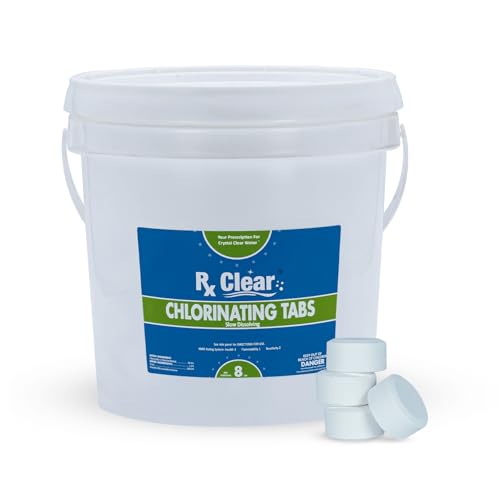
Rx Clear 1" Inch Chlorine Tabs | 8 Pounds | Use Tablets as Bactericide, Algaecide, & Disinfectant in...
- Stabilized for Consistent Chlorination: Formulated with a high percentage of available chlorine and built-in stabilizer, these 1-inch tablets help maintain steady...
- Slow-Dissolving Mini Tablets: Compact 1" tablets dissolve gradually to deliver a measured release of sanitizer over time. Ideal for floaters, small automatic feeders, and...
- Ideal for Spas & Small Pools: The smaller tablet size makes them well-suited for hot tubs, above ground pools, plunge pools, and other systems requiring lower output...
Use Rx Clear 1″ tablets when you need high-strength, low-odor chlorination for busy residential pools. Measure dosage, follow label directions. Add 1 tablet per 5,000 gallons in a floater, or use an automatic feeder set to maintain 1–3 ppm. Use test strips before and after. Expect slow dissolving tablets, compatible with vinyl, tile, fiberglass, gunite, monitor cyanuric acid, protect liners via UV stabilization. Avoid direct contact with skin. If chlorine drops, check dispenser flow, clean strainer, shock with calcium hypochlorite, retest after four hours, adjust pump run time accordingly. Store in a cool, dry place. Contact manufacturer for specifics.
Best For: Ideal for busy residential pool owners who want high‑strength, low‑odor chlorination with long‑lasting tablets that are compatible with common pool surfaces.
Pros:
- High available chlorine (90%) for effective algae and bacteria control.
- Slow‑dissolving tablets suitable for floaters, dispensers, and automatic feeders.
- UV‑stabilized formulation helps protect pool liners from fading.
Cons:
- Slow dissolution means it acts more gradually and may not be suitable for emergency shock treatment.
- Requires regular testing and monitoring of chlorine and cyanuric acid levels.
- Can irritate skin on direct contact; must be stored and handled carefully.
Rx Clear 1″ Chlorine Tablets for Swimming Pools (25 lb)
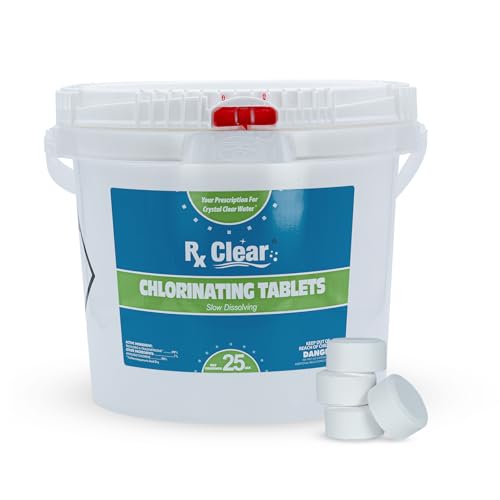
Rx Clear 1" Inch Chlorine Tabs | 25 Pounds | Use Tablets as Bactericide, Algaecide, & Disinfectant...
- Stabilized for Consistent Chlorination: Formulated with a high percentage of available chlorine and built-in stabilizer, these 1-inch tablets help maintain steady...
- Slow-Dissolving Mini Tablets: Compact 1" tablets dissolve gradually to deliver a measured release of sanitizer over time. Ideal for floaters, small automatic feeders, and...
- Ideal for Spas & Small Pools: The smaller tablet size makes them well-suited for hot tubs, above ground pools, plunge pools, and other systems requiring lower output...
Select Rx Clear 1-inch chlorine tablets when you maintain large, in-ground pools and need long-lasting, stabilized sanitation. Use the 25 lb bag to dose floaters, inline feeders, or automatic feeders, aim for 1 to 3 ppm free chlorine. Monitor with a DPD test kit, adjust tablet feed rate, increase circulation by running pump 8 to 12 hours daily. Expect 90% available chlorine, UV-stabilized formula, slow-dissolving tablets that act as bactericide and algaecide. Place tablets only in chlorinators, don’t drop into skimmer, avoid mixing with other chemicals. If irritation occurs, test pH and cyanuric acid, shock with unstabilized chlorine as needed weekly.
Best For: Homeowners or pool maintenance professionals with large in-ground pools who need a long-lasting, stabilized chlorine source for floaters, inline feeders, or automatic feeders.
Pros:
- Slow-dissolving, UV‑stabilized 1″ tablets provide consistent sanitization and protection against algae and bacteria.
- High available chlorine (90%) reduces odors and skin irritation while maintaining effective disinfection.
- Compatible with all common pool surfaces and safe for family and pets when used as directed.
Cons:
- Strong oxidizer—must not be mixed with other chemicals and can cause irritation if levels are not monitored.
- Tablets should only be used in chlorinators/floaters and never placed directly in the skimmer.
- Requires regular testing (DPD), pH and cyanuric acid monitoring, and adequate pump runtime (8–12 hours/day) to maintain proper levels.
ClearView 1-Inch Chlorine Tablets for Pools and Spas (5 lb)
Identify the ClearView tablets by their concentrated strength and pack size, ideal for small pools and busy spa owners. Measure pool volume. Use one tablet per 1,000 gallons, calibrated for pools up to 1,000 gallons, adjust for higher loads. Place tablets in floaters. Prefer feeders or skimmer baskets for even dissolution, note 0.7 ounce tablets dissolve slowly over about one week. Check dispenser fit. Confirm diameter approximately 1.25 inches, replace dispensers if tablets bind, consider 2 lb or 10 lb options. Monitor chlorine levels. Test free chlorine daily, with 90% available chlorine these tablets stop algae, prevent scale, corrosion.
Best For: Ideal for owners of small pools, spas, and hot tubs who want a slow‑dissolving, high‑strength stabilized chlorine tablet for easy, weekly sanitization.
Pros:
- 90% available chlorine provides strong sanitization to stop algae and kill bacteria.
- Slow‑dissolving 0.7 oz tablets last up to about one week, reducing dosing frequency.
- Compatible with vinyl liners and saltwater systems and usable in floaters, feeders, or skimmer baskets.
Cons:
- Tablet diameter (~1.25″) may not fit all dispensers — can bind and require replacing the dispenser.
- Pack and dosing are calibrated for up to 1,000 gallons; larger pools need dose adjustment or more frequent use.
- Stabilized formula means you must monitor free chlorine and cyanuric acid levels regularly to avoid over‑stabilization or imbalanced chemistry.
XtremeClear 1″ Slow-Dissolving Chlorine Tabs for Swimming Pools, Hot Tubs & Spas (1.5 lb)

XtremeClear 1" Chlorine Tabs Swimming Pool Hot Tub & Spa Eliminate Bacteria & Algae Sanitizer Makes...
- Versatile Application - Designed for use in pool skimmers, floating dispensers, & automatic chlorinators, these chlorinating tablets offer flexible compatibility for...
- Compatible With All Pools - Great for all pool types, including saltwater systems; Use 1" tabs for above ground pools. Use in floater, feeder, or skimmer basket (Floating...
- Long-Lasting Chlorine Tabs - Each tab is pre-stabilized against the sun's UV rays to prevent premature chlorine burn-off, making them last longer. Ideal for homeowners...
Pool owners managing mixed systems, choose XtremeClear’s pre-stabilized 1‑inch tabs in a 1.5 lb pack for straightforward dosing and extended longevity. Test free chlorine and pH before adding a tablet. Place one tablet in a floater, feeder, or skimmer basket, avoid direct contact with vinyl and plastics. Adjust circulation pump to medium flow for even dispersal. Expect slow dissolution up to one week, monitor residuals with a DPD test kit, retest every 24 hours. Keep stabilizer levels in range. If algae persists, shock with non-chlorine oxidizer, verify stabilizer, increase circulation, remove debris, consult label for safety precautions. Act promptly.
Best For: Pool and spa owners who want an easy, long-lasting, pre-stabilized chlorine tablet for routine sanitization and reduced maintenance.
Pros:
- Slow-dissolving (up to one week) for consistent chlorine release and fewer daily additions.
- Pre-stabilized against UV helps reduce chlorine burn-off and conserves water by lowering change frequency.
- Versatile use in floaters, feeders, or skimmer baskets and compatible with above-ground and saltwater systems.
Cons:
- Contains trichloro (stabilized chlorine) which can raise cyanuric acid over time and may require periodic dilution or management.
- Acidic nature can lower pH, so users must monitor and adjust pH regularly.
- Strong chemical — avoid direct contact with vinyl/plastics and never mix with other pool chemicals; requires careful handling and storage.
XtremeClear 1-Inch Chlorine Tablets, 2-Pack (3 lbs total)
Sale
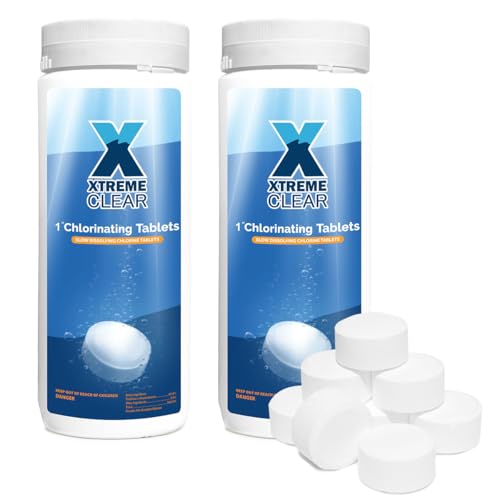
XtremeClear Value Pack 2 Pack 1" Chlorine Tabs, Long-Lasting Stabilized, Swimming Pool, Hot Tubs...
- Versatile Application - Designed for use in pool skimmers, floating dispensers, & automatic chlorinators, these chlorinating tablets offer flexible compatibility for...
- Compatible With All Pools - Great for all pool types, including saltwater systems; Use 1" tabs for above ground pools. Use in floater, feeder, or skimmer basket (Floating...
- Slow-Dissolving Formular - Each tablet is stabilized for UV protection & dissolves gradually to help maintain consistent chlorine levels in pool water. Supports clear...
Caretakers of above-ground pools, hot tubs, and spas will prefer XtremeClear’s slow-dissolving, stabilized 1-inch tablets for reliable weekly dosing and UV protection. Measure chlorine demand quickly. Add one tablet per 5,000 gallons using a feeder or skimmer basket, floaters sold separately. Handle bottles with gloves. Store two one-point-five pound bottles totaling three pounds in a cool, dry place, keep lids tight. Test free chlorine daily. If chlorine reads low, add another tablet, wait 24 hours, retest with DPD kit, adjust accordingly. Expect weekly. For salt systems, confirm compatibility, monitor cyanuric acid levels, reduce tablets if CYA exceeds 80 ppm.
Best For: Caretakers of above‑ground pools, hot tubs, and spas who want a slow‑dissolving, stabilized weekly chlorine solution that works with floaters, feeders, or skimmer baskets.
Pros:
- Long‑lasting 1″ tablets dissolve slowly (up to ~1 week) for low‑maintenance dosing.
- Pre‑stabilized against UV helps reduce chlorine burn‑off and saves on chlorine use.
- Versatile and compatible with most pool types, including saltwater systems and multiple dispenser options.
Cons:
- Contains stabilized chlorine (trichloro) that raises cyanuric acid (CYA) over time—monitor and reduce use if CYA > 80 ppm.
- Floater/dispenser sold separately, so additional purchase may be needed for automatic dosing.
- Strong chemical—requires careful handling (gloves), proper storage, and can irritate skin/eyes if mishandled.
Factors to Consider When Choosing 1 Inch Chlorine Tablets
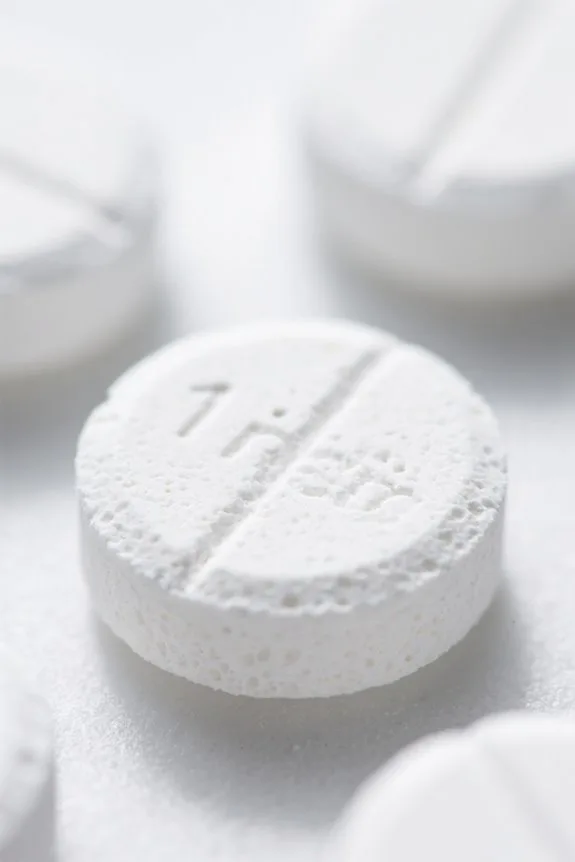
Measure available chlorine percentage and target ppm, use a test kit, aim for 1–3 ppm free chlorine after dosing. Check stabilizer (cyanuric acid) levels with a colorimeter, keep 30–50 ppm, troubleshoot UV loss or overdosing if exceeding 60 ppm. Assess dissolution rate and tablet dispenser fit, choose a floater or inline feeder, discard crumbling tablets to prevent staining.
Chlorine Concentration
Check the tablet label for available chlorine, noting most 1-inch tablets list 90% to 99% active ingredient by weight. Select concentration based on pool volume, test kit readings, and daily bather load. Use a bucket, nitrile gloves, and chlorine-resistant tongs when handling tablets. Add tablets to floater or automatic feeder, set feed rate in grams per hour, monitor free chlorine with DPD test strips twice daily. For heavy demand, choose 98–99% tablets, increase feed rate, and retest after 1–2 hours. If chlorine spikes, aerate the pool with pump and return jets, lower pH with sodium bisulfate, and recheck levels. Document dose, time, equipment used, and any adverse reactions. Consult manufacturer SDS for storage, compatibility, and emergency contact details. Keep away from acids, organics, indoors.
Stabilizer Content
Although sunlight rapidly degrades free chlorine, choose 1‑inch tablets with appropriate stabilizer content to prolong residual, reduce demand, and limit daily dosing. Measure cyanuric acid (CYA) percentage, target 30–50 ppm for outdoor pools. Select tablets labeled with stabilizer percentages, check product datasheets, verify active CYA content per tablet using manufacturer specifications. Use a digital test kit, or pool test strips, to monitor CYA weekly. Adjust dosing by adding one tablet per 5,000 gallons, wait 24–48 hours, retest CYA and free chlorine, repeat as needed. Inspect stabilizer distribution with a floating tablet feeder or automatic chlorinator, avoid direct tablet contact with vinyl liners. Troubleshoot low residual by confirming tablet brand quality, testing for binder residues, and increasing CYA incrementally until stability is achieved. Document changes.
Dissolution Rate
Consider dissolution rate first, and choose tablets that match your pool’s turnover and maintenance schedule. Test tablets in a floater. Select slow-dissolving tablets rated to last 5 to 7 days per 10,000 gallons for weekly feeding, especially under sunlight. Use a test kit. Monitor free chlorine with a Taylor K-2006 or pool strip, record ppm twice daily, adjust float height or tablet count. Check water temperature. Expect faster dissolution above 80°F, increase tablet numbers or switch to slower formula if levels drop below 1.0 ppm. Troubleshoot cloudy water. If tablets crumble, inspect feeder, clean impeller, sample pH and alkalinity, correct pH to 7.4–7.6 with muriatic acid or sodium bicarbonate. Replace damaged tablets. Store unopened packs dry, between 50°F and 80°F, in original container, securely.
Pool Compatibility
Match tablet chemistry to your pool surface and system, and inspect labels for vinyl-safe, plaster-safe, fiberglass-safe, or tile-safe wording before you buy. Check label for saltwater compatibility. Calculate dosing by pool volume, note that one 1-inch tablet treats about 1,000 gallons, adjust tablet count accordingly. Use floaters, in-line feeders, or skimmer baskets as appropriate. Place tablets in a chlorinator with flow control, monitor ppm with a DPD test kit, aim for 1.0–3.0 ppm free chlorine. Avoid dropping tablets directly on vinyl liners to prevent bleaching. If cloudiness or surface etching appears, stop tablet use, test stabilizer (CYA), total alkalinity, and calcium hardness, then consult manufacturer guidelines. Replace incompatible tablets immediately. Document product batch and expiration dates, keep MSDS on file for chemical safety, troubleshooting.
Tablet Dispenser Fit
How will you guarantee your dispenser accepts 1-inch tablets; measure tablet diameter and dispenser throat immediately. Measure tablets from edge to edge with calipers, record actual diameters in inches and millimeters precisely. Check for common variance, note that many “1-inch” tablets measure about 1.25 inches, so verify fit before purchasing. Inspect dispenser throat opening and internal basket, compare opening to tablet diameter, ascertain at least 0.1–0.2 inch clearance. Determine whether your dispenser is rated for slow-dissolving or fast-dissolving tablets, match tablet dissolve profile to flow rate. Adjust flow valve or choose a different dispenser if dissolve rate exceeds flow capacity, prevent over-chlorination or under-dosing. Use manufacturer-tested dispenser-tablet combinations when possible, follow product compatibility lists. Document measurements and photos for reference during seasonal maintenance annually.
Recommended Dosage
1 tablet per 1,000 gallons is the baseline, measure your pool volume precisely in gallons before dosing, record that number for repeat accuracy. Calculate required tablets, divide total gallons by 1,000 and round to nearest whole tablet unless manufacturer specifies otherwise. For above-ground pools, use one tablet per 1,000 gallons, for many inground pools expect up to three tablets based on circulatory conditions and bather load. Test chlorine with a DPD test kit or test strips, aim for 1–4 ppm free chlorine and log results after four hours. Use a floating chlorine feeder or inline chlorinator for slow-dissolving tablets, adjust feeder vents to modify dissolution rate. Troubleshoot low chlorine by checking pump runtime, filter cleanliness, and stabilizer (cyanuric acid) levels. Reassess weekly and adjust.
Safety Precautions
Gloves and goggles: put them on before you handle any chlorine tablets, always. Wear nitrile gloves, ANSI-rated goggles, and a dust mask. Store tablets in a sealed, corrosion-resistant container at 50–77°F (10–25°C), keep them dry and shaded. Lock the container and label it, store it at least 5 feet above floor level away from children and pets. Never mix trichloro tablets with acids, algaecides, or liquid chlorine, or you risk toxic gas evolution. Check lot numbers and expiration dates before dosing, discard tablets past manufacturer guidance. If tablets crumble, isolate them in a ventilated area, sweep residue with non-sparking tools, dispose according to local hazardous-waste rules. Test pool chlorine levels with a DPD kit after four hours, adjust dosage using a calibrated paddled feeder.
Price and Value
When comparing brands, calculate cost per pound or per tablet before you commit to a purchase, and use that baseline to judge value. Compare available chlorine percentages on labels. Prefer higher available chlorine, 56–62% in stabilized trichlor, it reduces dosing frequency and improves sanitation. Buy 25 lb bags when feasible. Calculate cost per tablet with a digital scale, weigh 10 tablets, divide total weight, confirm per-tablet price and discounts. Check for UV stabilizers and clarifiers on labels. Factor seasonal promotions, promo codes, and shipping costs, verify compatibility with chlorinator feeders or skimmer floaters before buying online. Anticipate storage needs, use sealed chemical storage cabinets. Troubleshoot cloudy water by increasing shock dose, test cyanuric acid and free chlorine with a test kit, adjust accordingly promptly.
Frequently Asked Questions
Are 1-Inch Chlorine Tablets Legal to Ship to My State?
Yes, you can ship 1-inch chlorine tablets to many states, but check local regulations first. Verify DOT and USPS restrictions, make sure you’re using sealed HDPE containers, desiccant packs, and UN-rated outer boxes, label with hazard class 5.1, and include SDS. Contact your carrier, request hazmat approval, note quantity limits like 5 kg per package, troubleshoot carrier refusals by splitting shipments or using bonded freight. Keep records and trace numbers.
Can These Tablets Be Used in Saltwater or Mineral Pool Systems?
Yes, you can, like a gentle nudge, use 1-inch chlorine tablets in saltwater and mineral pools. Measure stabilizer, maintain 1–3 ppm free chlorine, test daily with DPD kit. Use a floater or inline feeder, set feed rate to 2–4 tablets per week for 10,000 gallons, monitor cyanuric acid. Check salt cell, descaler monthly, reduce tablets if corrosion’s evident. Troubleshoot cloudy water, shock with 1 lb granular chlorine per 10,000 gallons.
Will Tablets Void My Pool Liner or Equipment Warranties?
No, don’t assume tablets will void your warranty. Read liner and equipment documents, note chemical clauses, list prohibited compounds, and record concentrations in ppm. Keep tablets in feeders recommended by manufacturers. Measure stabilizer with a test kit, keep free chlorine 1–3 ppm, maintain CYA below limit. Document every chemical change and equipment servicing. If manufacturer cites tablet damage, take photos, retain test logs, contact support, request repair authorization. Save records.
How Should I Store Unused Chlorine Tablets Safely Long-Term?
Store them like soldiers in a dry armory. Use original opaque HDPE pails or plastic canisters, label with date and concentration, keep away from sunlight. Control humidity, don’t store near acids, oxidizers. Maintain temperature below 25°C (77°F), use humidity indicators, install a vented cabinet with corrosion-resistant shelving, inspect monthly. Keep tablets by lot, avoid broken pieces. Wear nitrile gloves and goggles, use a digital hygrometer, discard clumped tablets per label.
What Are Biodegradable or Less-Toxic Alternatives to Chlorine Tablets?
Choose salt chlorination, ozone, UV, or mineral ionizers as alternatives. Install a salt chlorinator sized to gpm, maintain 1–3 ppm residual, don’t skip cell replacement regularly. Fit an ozone or UV unit to reduce chemical shocks. Size UV by flow, target 30–40 mJ/cm² dose with 40–80 W lamps, monitor lamp hours and replace promptly, inspect weekly. Check copper 0.2–0.4 ppm, silver 0.02–0.05 ppm, troubleshoot stains or cloudy water, adjust dosing.