As an Amazon Associate, we earn from qualifying purchases. Some links on this site are affiliate links at no extra cost to you. Our recommendations are based on thorough research and editorial judgment.


10 Best Calcium Hardness Increasers for Pools — Keep Water Balanced and Prevent Corrosion

Measure your pool volume precisely, use a calibrated test kit (Taylor K-2005), and record current calcium hardness in ppm. Dissolve calcium chloride granules in a plastic bucket, add 8 oz per 5,000 gallons for a 10–20 ppm rise, stir until clear. Wear gloves and goggles, run the pump 4 hours after addition, monitor for cloudiness or scale formation. If cloudiness appears, lower pH and backwash the filter. Continue for dosing charts, troubleshooting, and comparisons.
Key Takeaways
- Choose a product matched to pool type (plaster, vinyl, spa) for optimal protection and dissolution speed.
- Prioritize high-purity calcium chloride formulas for fast, predictable hardness increases and minimal contaminants.
- Follow manufacturer dosing and dissolve instructions; add near returns with pump running to avoid cloudiness and scaling.
- Test calcium, pH, and alkalinity before and 4–24 hours after dosing to avoid overshooting and corrosion.
- Handle with gloves/goggles, store dry, and measure pool volume accurately to calculate safe, effective dosing.
Pool Mate 16-Pound Calcium Hardness Increaser for Pools

Pool Mate 16-Pounds Premium Calcium Hardness Increaser for Pools, 100% Calcium Chloride
- Calcium chloride for pools
- Rapidly increases total hardness
- Helps prevent corrosion or etching of pools

You may be interested
Choose this 16-pound Pool Mate if you need a fast, budget-friendly fix for low calcium in plaster or concrete pools. Measure volume precisely. Add 8 ounces per 5,000 gallons to raise hardness by 10 ppm, dissolve in a bucket. Broadcast evenly, avoid pouring near skimmers. Run pump and filter 12 hours, test calcium after circulation, repeat dosing if below 200 ppm. Wear gloves. Address cloudiness by backwashing or vacuuming, check pH, alkalinity, and scale risk, monitor plaster for etching. Store product dry. If corrosion persists, consult a professional, consider alternative stabilizers, inspect metal fittings and heater components for damage.
Best For: Pool owners with plaster or concrete pools who need a fast, budget-friendly way to raise low calcium hardness to the recommended 200–400 ppm range.
Pros:
- Rapidly increases calcium hardness (8 oz per 5,000 gallons raises hardness ~10 ppm) for quick correction.
- 100% calcium chloride formula is effective and economical for routine maintenance.
- Helps prevent surface etching and corrosion when used to bring hardness into recommended range.
Cons:
- Risk of scale or cloudiness if over‑dosed or if pH/alkalinity aren’t balanced; requires monitoring.
- Can irritate skin—gloves recommended—and must be dissolved and handled carefully.
- Won’t fix underlying corrosion issues; persistent problems may need a professional inspection or other treatments.
Robelle 25-Pounds Premium Pool Calcium Up, Calcium Hardness Increaser

Robelle 25-Pounds Premium Pool Calcium Up, Calcium Hardness Increaser
- Calcium chloride for pools
- Rapidly increases total hardness
- Helps prevent corrosion or etching of pools
Use Robelle 25-pound Premium Pool Calcium Up when you need to rapidly raise calcium hardness, especially for plaster and vinyl-lined pools. Measure pool gallons precisely, calculate dose, remember 8 ounces raises hardness 10 ppm per 5,000 gallons. Dissolve product in a plastic bucket, wear gloves, goggles, never add dry granules directly to pool. Broadcast solution at returns, run pump two hours minimum, then retest with strips or digital meter. If readings vary, inspect circulation lines and skimmer flow, brush surfaces to help equalize hardness. Store sealed, dry, away from metals; log additions, contact supplier immediately if any corrosion appears.
Best For: Pool owners with plaster or vinyl-lined pools who need to rapidly raise and maintain calcium hardness to protect surfaces.
Pros:
- Rapidly increases calcium hardness (8 oz raises 10 ppm per 5,000 gallons) for quick correction.
- Protects pool surfaces from corrosion, staining, and etching when hardness is in the 200–400 ppm range.
- Simple dosing and application when dissolved properly; ideal for regular maintenance.
Cons:
- Must be handled carefully (dissolve in a plastic bucket, wear gloves/goggles, never add dry granules directly) to avoid skin/eye irritation and localized damage.
- Contains calcium chloride, which can corrode metals and increase total dissolved solids—store sealed and dry away from metals.
- Overuse can push hardness too high, increasing risk of scaling and cloudy water.
Clorox Pool&Spa Calcium Hardness Increaser for Swimming Pools, 4 lb

Clorox® Pool&Spa™ Swimming Pool Calcium Hardness Increaser, Prevents Corrosion, Etching and...
- Prevents Corrosion, Etching, and Staining: With Clorox Pool&Spa Swimming Pool Calcium Hardness Increaser, you can safeguard your pool against corrosion, etching, and...
- Increases Low Total Hardness Levels: This product helps increase the low total hardness levels in swimming pool water, ensuring a balanced and stable environment for your...
- Extends Equipment Life: Unbalanced water can cause a corrosive environment that damages your pool surfaces or equipment. This product prevents pool surface damage...
Test total hardness immediately with a reliable test kit. Use Clorox Pool&Spa Calcium Hardness Increaser, 4 lb, to raise low hardness in plaster pools, and prevents etching and staining reliably. Measure dosage precisely. Add 1.5 pounds per 10,000 gallons to increase hardness approximately 10 ppm, disperse slowly near returns. Use protective gloves and a scoop. Broadcast product evenly, run pump 4–6 hours, retest total hardness before repeating any treatment. Consult the Clorox Pool App. Enter pool volume, current hardness, and the app gives dosage, timing, and troubleshooting guidance for soft water areas. Expect reduced corrosion and extended equipment life.
Best For: Pool owners with plaster or soft-water pools who need to raise low calcium hardness to prevent corrosion, etching, and staining.
Pros:
- Raises calcium hardness reliably (1.5 lb per 10,000 gallons ≈ +10 ppm) to protect surfaces and equipment.
- Helps prevent corrosion, etching, and staining, extending pool surface and equipment life.
- Simple application with clear dosage, dispersal instructions, and Clorox Pool App guidance for testing and dosing.
Cons:
- Overdosing can cause scaling; requires careful measurement, protective gloves, and retesting before repeating treatment.
- Best suited for plaster pools—may not be ideal for all pool types (e.g., some vinyl or specialty surfaces).
- 4 lb package may require multiple purchases for large pools or repeated treatments.
In The Swim Calcium Hardness Increaser for Swimming Pools (25 lb)

In The Swim Calcium Hardness Increaser for Swimming Pools - Fast-Acting, Scale Prevention...
- Boost Water Quality: Prevent cloudy, dull water by restoring the right calcium levels in your pool
- Protect Your Pool: Helps stop costly damage like corrosion and pitting on pool surfaces and equipment
- Easy-to-Use Granules: Fast-dissolving formula works quickly—just measure, pour, and circulate
Determine if you manage an inground residential pool or commercial system, then confirm hardness with a reliable test kit.
Use gloves and eye protection.
Measure pool volume precisely, calculate dose knowing 6 pounds raises hardness 50 ppm per 10,000 gallons.
Dissolve granules only if nozzle or feeder recommends it.
Pour fast-dissolving 94% calcium chloride granules near return jets while pump circulates, prevent localized etching.
Retest after four hours.
Repeat dosing as needed, avoid overshooting recommended ranges to prevent cloudy water and scale formation.
Address corrosion signs immediately.
Use industrial-grade product cautiously, it doubles as snow and ice melt seasonally.
Best For: homeowners and commercial pool operators who need a fast, effective way to raise calcium hardness and protect plaster and equipment.
Pros:
- High-strength formula (94% calcium chloride) in a 25 lb bag raises hardness quickly (6 lb → +50 ppm per 10,000 gal).
- Fast-dissolving granules for easy measure, pour, and circulate application near return jets.
- Helps restore water clarity and prevents corrosion/pitting; also doubles as industrial-grade ice/snow melt for seasonal use.
Cons:
- Overdosing can cause cloudy water and scale formation, so precise measuring and retesting are required.
- Corrosive—requires gloves and eye protection and improper application can cause localized etching.
- Industrial-grade product may be overkill or require extra caution for small residential systems.
AquaDoc Calcium Hardness Increaser for Hot Tubs
Sale

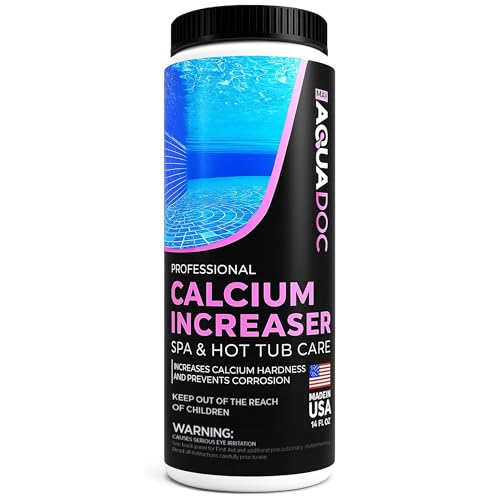
AquaDoc Spa Calcium Hardness Increaser Hot Tub Owners Rely on, Calcium Increaser Spa Hardness...
- Make balancing your water easier & more cost effective with AquaDoc's calcium hardness increaser. Our spa calcium hardness increaser is vital to ensuring proper water...
- Avoid corrosion, etching, and staining - AquaDoc's Professional Grade Hot Tub Calcium increaser is your best defense against soft water in your hot tub or spa. Guard...
- How it works - AquaDoc's Hot Tub Calcium hardness Increaser works to raise your water's hardness level to ensure properly balanced hot tub water. Our spa hardness...
If you own a hot tub and want precise, incremental control over calcium levels, choose AquaDoc Spa Calcium Hardness Increaser, it’s tailored for spas and small-volume systems. Test current calcium hardness first. Measure with a reliable test kit, note ppm, then calculate ounces since 1 ounce raises 10 ppm per spa. Add measured increaser while the pump runs. Run the filter for one to two hours, wait twenty minutes, retest hardness, repeat dosing for gradual adjustment. If you overshoot, dilute with fresh water. Use professional-grade AquaDoc produced in USA for consistent results, store sealed, and follow safety gear recommendations.
Best For: Hot tub and spa owners who need precise, incremental control of calcium hardness in small-volume systems.
Pros:
- Raises calcium hardness in small, accurate increments (1 oz = 10 ppm) for fine-tuned adjustment.
- Professional-grade formula produced in the USA for consistent, reliable results.
- Simple procedure: add while pump runs, filter 1–2 hours, wait 20 minutes and retest.
Cons:
- Requires accurate testing and careful dosing to avoid overshooting levels.
- Not intended for large pools—formulated specifically for spas/small-volume systems.
- If levels become too high you must dilute with fresh water, which can be inconvenient.
In The Swim Calcium Hardness Increaser for Swimming Pools (45 lb)

In The Swim Calcium Hardness Increaser for Swimming Pools - Fast-Acting, Scale Prevention...
- Boost Water Quality: Prevent cloudy, dull water by restoring the right calcium levels in your pool
- Protect Your Pool: Helps stop costly damage like corrosion and pitting on pool surfaces and equipment
- Easy-to-Use Granules: Fast-dissolving formula works quickly—just measure, pour, and circulate
Choose this 45 lb, 94% calcium chloride formulation when you manage larger, plaster or vinyl-lined pools and need a reliable, bulk solution. Measure with a digital test kit, calculate dosage using 6 lbs per 10,000 gallons to raise hardness 50 ppm. Dissolve granules in a bucket of pool water, use a pump or hose to dilute before pouring. Pour slowly around deep end while circulating with the main pump, run pump two hours to disperse evenly. Wear chemical-resistant gloves and goggles, avoid adding near skimmer to prevent scale buildup. If cloudiness persists, retest, adjust pH, vacuum, or contact support.
Best For: Pool operators or homeowners managing larger plaster or vinyl-lined pools who need a reliable, bulk calcium chloride solution to quickly raise calcium hardness.
Pros:
- High concentration (94% calcium chloride) and large 45 lb size provides cost-effective, bulk dosing for big pools.
- Fast-dissolving granules with a clear dosing metric (6 lbs per 10,000 gallons = +50 ppm) make corrections predictable and effective.
- Multi-use formulation (also suitable as industrial-grade ice/snow melt) increases versatility and value.
Cons:
- Can overshoot desired hardness if not measured carefully; requires a digital test kit and accurate dosing calculations.
- Must be handled and applied with care (chemical-resistant gloves/goggles, dissolve before pouring, avoid skimmer) to prevent localized scaling or damage.
- Not ideal for small pools or users wanting pre-measured/consumer-sized packaging due to the large 45 lb bulk size.
SpaGuard Spa Calcium Hardness Increaser (12 oz, 3-Pack)
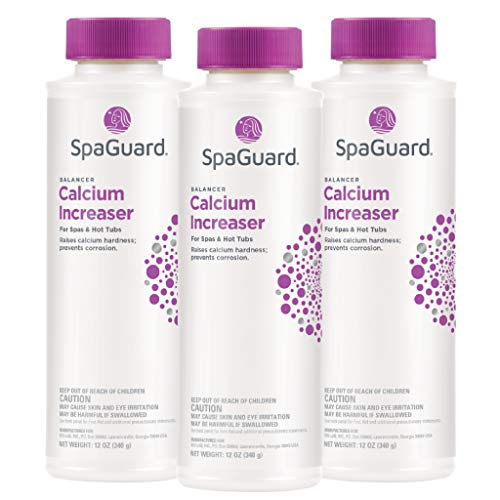
SpaGuard Spa Calcium Hardness Increaser (12 oz) (3 Pack)
- Boosts Calcium Hardness: SpaGuard's Calcium Hardness Increaser enables spa owners to increase their calcium hardness with this easy to use granular formula, which will...
- Keeps Optimal Calcium Level: It helps raise the calcium level steadily to the optimal calcium hardness level of 200-400 ppm, to keep the spa water from becoming corrosive...
- Protects Spa & Equipment for Longer Life: This helps protect your hot tub against corrosion, extending the life of your equipment and hot tub surfaces.
Spa owners who need precise, small-batch dosing will find this 12 oz, 3-pack granular formula ideal for routine maintenance. Measure water volume. Use a digital scale or graduated cup, calculate dose to raise calcium to 200-400 ppm based on gallons. Add granules slowly. Dissolve in bucket with warm water if jets are off, pour by return, run pump 15 minutes. Retest after 24 hours, promptly. If levels exceed 400 ppm, drain 10-20%, refill with fresh water, retest and adjust dose. Use with chlorine, bromine, ozone, biguanide. SpaGuard protects heaters, jets, fixtures, and plumbing, reducing corrosion and extending equipment life.
Best For: Spa owners who need precise, small-batch calcium adjustments and equipment protection with an easy-to-use granular formula.
Pros:
- Easy-to-dose 12 oz granular packets ideal for small spas and precise adjustments.
- Protects heaters, jets, fixtures, and plumbing by raising calcium hardness to recommended 200–400 ppm.
- Compatible with chlorine, bromine, ozone, and biguanide sanitizers for versatile use.
Cons:
- Overdosing can push calcium above 400 ppm, necessitating a partial drain and refill.
- Requires accurate measurement, dissolution, and retesting (24-hour wait), adding time and effort.
- Smaller packet sizes may be inconvenient for large-volume spas or frequent adjustments.
Pool Mate Calcium Hardness Increaser (25 lb)

Pool Mate 25-Pounds Premium Calcium Hardness Increaser for Pools, 100% Calcium Chloride
- Calcium chloride for pools
- Rapidly increases total hardness
- Helps prevent corrosion or etching of pools
Pool owners who need a fast, reliable way to correct low calcium hardness will find this 25 lb, 100% calcium chloride formula ideal for restoring levels without adding impurities. Measure 8 ounces per 5,000 gallons, use a digital scale or calibrated scoop, record calculations. Dissolve product in a clean plastic bucket using warm water, stir with a nonmetallic paddle until fully dissolved, then cool. Pour diluted mix gradually, keep pump running, monitor hardness, watch for cloudiness or white residue. Store unopened bag in a cool dry place, handle with gloves and eye protection, follow MSDS and label instructions carefully.
Best For: Pool owners needing a fast, reliable way to raise low calcium hardness and protect pool surfaces.
Pros:
- Rapidly increases total hardness (8 oz raises 10 ppm per 5,000 gal) for quick correction.
- 100% calcium chloride formula adds no impurities and helps prevent corrosion, etching, staining.
- Comes in a 25 lb supply suitable for multiple treatments and ongoing maintenance.
Cons:
- Must be dissolved and added carefully (use warm water, nonmetallic paddle) to avoid application issues.
- Can cause temporary cloudiness or white residue if overused or not fully dissolved.
- Corrosive and moisture‑sensitive — requires gloves, eye protection, and cool, dry storage per MSDS.
Leisure Time Calcium Booster (1 lb)
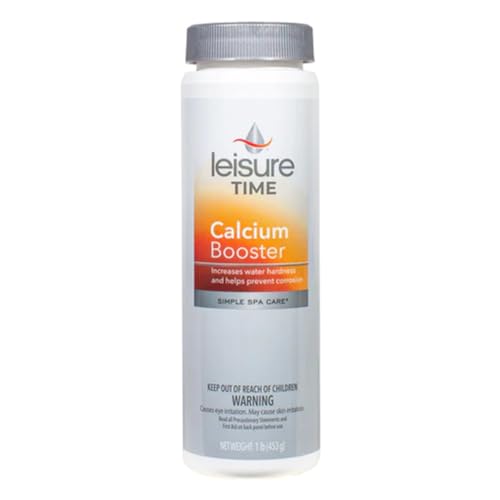
Leisure Time 22330 Calcium Booster for Spas and Hot Tubs, 1 lb
- WORKS FAST: Quick dissolving and goes to work immediately
- WATER BALANCE: Helps maintain proper mineral balance, preventing foaming, pitting, and equipment damage.
- EASY: Compatible with all sanitizers. Simple, fast‑dissolving formula designed for quick adjustments in any spa or hot tub.
If your system uses chlorine, bromine, ozone, or biguanide, use Leisure Time Calcium Booster 1 lb because it raises hardness, prevents foaming, and limits equipment corrosion for low-hardness water. Measure pool volume; know exact gallons. Add one pound per 10,000 gallons for a 10–20 ppm hardness rise, use a bucket and stir. Broadcast granules slowly, avoid clumping. Run pump and filter 8–12 hours, monitor hardness with a Taylor kit, record maintenance, log results daily. Repeat dosing if results remain low. If foaming persists, inspect skimmer, clean cartridge, backwash DE, verify chemical compatibility. Store sealed container in cool, dry place.
Best For: Home spa and hot tub owners with low-calcium (soft) water who want to raise hardness to prevent foaming and protect equipment.
Pros:
- Raises water hardness predictably (approx. 10–20 ppm per lb per 10,000 gallons) to reduce foaming and corrosion.
- Compatible with chlorine, bromine, ozone, and biguanide systems.
- Easy granular application; dissolves when broadcast and run with pump for 8–12 hours.
Cons:
- Requires accurate water-volume measurement and periodic testing; may need repeat dosing to reach target hardness.
- Can contribute to scale if overused or if baseline hardness is already high.
- Granules can clump if added improperly and must be stored sealed in a cool, dry place.
Robelle 16-Pounds Premium Pool Calcium Up, Calcium Hardness Increaser

Robelle 16-Pounds Premium Pool Calcium Up, Calcium Hardness Increaser
- Calcium chloride for pools
- Rapidly increases total hardness
- Helps prevent corrosion or etching of pools
Choose the Robelle 16-pound bag when you need a reliable, granular calcium hardness increaser for low-hardness water. Test calcium hardness with a reliable kit first. Measure pool gallons, consult the dosage chart, mix up to 2 pounds per 5-gallon plastic bucket. Dissolve thoroughly before adding. Run the circulation pump, pour the dissolved solution evenly around the pool perimeter while observing for cloudiness. Respect the maximum 10 pounds per 10,000 gallons rule. Wait two hours, retest hardness, adjust only if vinyl pools are below 200–300 ppm or tile below 200–400. Contact Robelle customer service for warranty or pricing issues.
Best For: Pool owners with low-calcium water who need a reliable, granular product to raise calcium hardness and protect pool surfaces.
Pros:
- Increases total hardness effectively to prevent corrosion, etching, and staining.
- Dry granular form dissolves in a bucket for even distribution around the pool perimeter.
- Clear dosing guidance and safe maximum (10 lb per 10,000 gal every 2 hours) for controlled adjustments.
Cons:
- Requires accurate testing, measuring pool volume, and careful dosing to avoid overcorrection.
- Adjustment can be slow—may need repeated additions and retesting to reach target ppm.
- Not suitable for pools with already high calcium hardness (risk of scaling).
Factors to Consider When Choosing a Calcium Hardness Increaser
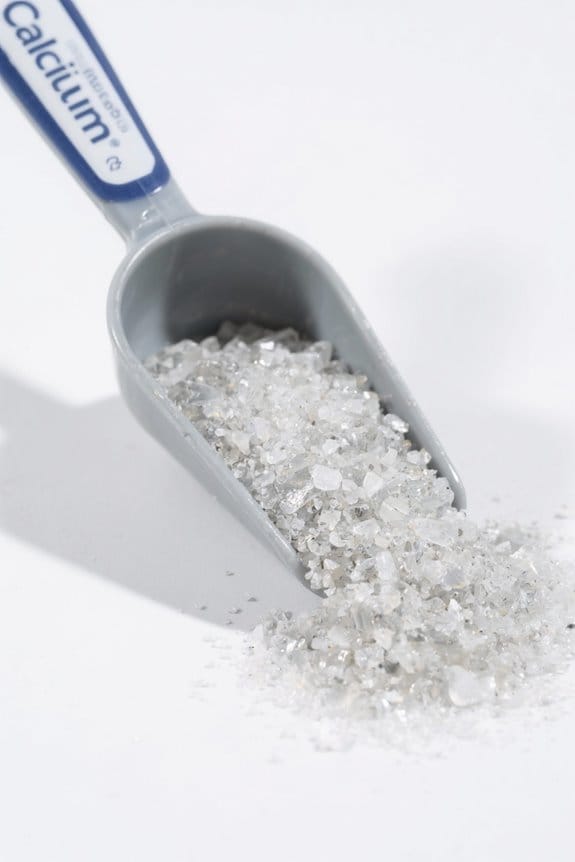
Check your pool type—concrete, vinyl, fiberglass—measure volume in gallons, and note current calcium ppm with a digital photometer. Use a high-purity calcium chloride (≥75% CaCl2·2H2O), follow label dosage per 10,000 gallons, check sanitizer compatibility. Measure dosing with a calibrated scale to 0.1 oz accuracy, stir, retest after 4–6 hours, if scaling occurs lower pH and add chelant.
Pool Type
Because you’re working with different finishes, identify your pool type first, then test calcium hardness with a Taylor or LaMotte test kit, record ppm, and note current pH and total alkalinity. Determine whether your pool is vinyl, tile/aggregate, marcite, fiberglass, plaster, or painted. Aim vinyl at 200–300 ppm, add increments slowly, retest after circulation. For tile and aggregate, target 200–400 ppm, prevent corrosion and etching by staying near midpoint. For marcite, fiberglass, or painted finishes, maintain 250–400 ppm to avoid staining and finish degradation. Use granular calcium chloride, measure dose per manufacturer instructions, calculate dosage for your pool volume. If hardness rises too fast, perform partial water replacement, then rebalance pH and alkalinity, and retest within 24 hours. Document changes and adjust future dosing.
Calcium Purity
Label the product and inspect its certificate of analysis, demand a stated purity percentage and manufacturer lot number. Prefer 100% calcium chloride products, avoid fillers. Verify minimal additives on the SDS, confirm composition, and compare manufacturer purity statements for consistency and externally. Test purity with a titration kit first. Use a calibrated spectrophotometer or turbidity meter, record readings, and flag cloudiness or particulate formation immediately log. Avoid products with visible anti-caking agents listed. If you see staining, run a 0.45 micron filtration test, inspect filters, photograph discoloration, then consult the manufacturer. Request a COA for every lot. Keep a sample, store at 4°C in amber bottles, label date and lot, perform periodic reanalysis with the same calibrated instruments, and update your water treatment records.
Dosage Accuracy
Calculate pool volume precisely using length × width × average depth, convert cubic feet to gallons, record total gallons, then determine the required dose. Measure with a tape measure and a pool depth gauge, note skimmer and deep end depths. Use test kit strips or a digital hardness meter, test before dosing and record ppm. Follow product label, many recommend 8 ounces per 5,000 gallons to raise 10 ppm. Calculate proportional dose based on your gallons and current ppm deficit, use a kitchen scale or measuring scoop for accuracy. Pre-dissolve granules in a bucket with warm water for easier distribution, avoid adding near the skimmer. Retest after 24 hours, troubleshoot cloudy water or scaling by adjusting future doses. Document each adjustment, keep maintenance logs.
Dissolution Rate
When comparing products, check the manufacturer’s stated dissolution time, note water temperature ranges (60–90°F), and factor in your pump’s flow rate and turnover, so you know how quickly hardness will actually rise. Choose fast-dissolving granules for rapid correction. Measure dose precisely with a digital scale, add measured grams per 10,000 gallons. Pre-dissolve in a bucket with 2–4 gallons of pool water, stir with a pool brush, then pour near returns. Monitor ppm with a photometer or test strips at 1, 4 and 24 hours, retest after six hours if circulation is low. If undissolved residue forms, check pump RPM, clean filter cartridges, and raise water temperature slightly within safe limits. Plan dosing around turnover time, avoid stacking doses, and document changes in maintenance log.
Sanitizer Compatibility
Because your sanitizer can change chemical behavior, check compatibility before adding any calcium hardness increaser to the pool. Read product labels for chlorine, bromine, ozone, and biguanide notes. Measure current calcium with a digital test kit or professional titration, record ppm and temperature. Compare manufacturer compatibility charts before dosing any granular or powdered increaser. If using chlorine, avoid formulations that note reactive ingredients, stop dosing and contact support if cloudiness appears. Carry a spare ppm test strip and wear goggles and nitrile gloves. For bromine or biguanide systems, choose labeled products, monitor sanitizer residuals hourly for four hours after addition. Document results and adjust dosing schedule, consult technician if residuals deviate by over 0.3 ppm. Perform monthly checks, replace incompatible increasers immediately to protect finish.
Package Size
Pick from 1-pound tubs up to 45-pound bags, match package size to your pool volume and dosing frequency. Prefer small tubs for top-ups. Measure pool volume in gallons, target increases in ppm, then determine pounds required per treatment using product label dosage. Store unopened bags in a cool, dry utility cabinet. Use PPE like gloves and dust mask, weigh on a digital scale to dose accurately, avoid clumping and spills. Buy bulk only if you can rotate supply within a year. Plan contingencies, keep one 1-pound tub for quick 20 ppm corrections, store a plastic scoop and bucket. Check label for moisture resistance and manufacturer date. If product cakes, sieve with a plastic strainer, note humidity in storage, contact manufacturer for guidance.
Price per Pound
Measure your pool volume in gallons, then determine the target ppm increase. Calculate required pounds using product dosing charts, use a digital scale and a calculator for precision. Compare price per pound, expect $0.50 to $3.00 ranges. Favor bulk containers like 25 lb or 50 lb bags when maintaining pools over 10,000 gallons, to lower unit cost. Check active ingredient concentration. Compare percent calcium content on labels, higher concentrations can reduce needed mass and overall expense per effective ppm. Watch for seasonal sales and coupons. Calculate total cost by multiplying required pounds by the unit price, include tax, shipping, or handling fees for accuracy. Troubleshoot discrepancies by rechecking volume and test kit calibration. Document purchases and dosing outcomes for future budgeting, pool chemistry consistency.
Storage and Handling
Store calcium hardness increaser in a cool, dry area below 80°F, out of direct sunlight, and out of reach of children and pets. Use PPE, including nitrile gloves, goggles, and a dust mask, before handling powders or concentrated granules. Keep containers labeled, sealed, and stored separately from acids and chlorine products, on shelves 12–18 inches above floor to prevent moisture wicking. Transport products upright in a locked trunk or secured crate, check for leaks, and clean spills immediately with dry absorbent, avoid water. If you encounter caking, break up with a plastic scraper, note humidity levels, and transfer to a fresh airtight HDPE container. Inspect seals monthly, record storage temperature, and rotate stock using FIFO. Follow MSDS instructions for emergency response and chemical compatibility.
Frequently Asked Questions
Is Calcium Hardness Increaser Safe for Stainless Steel Pool Fittings?
Yes, keep calcium hardness at 200–400 ppm to protect stainless steel fittings.
Use calcium chloride granules, dose 1.5 ounces per 10,000 gallons to raise hardness 10 ppm, measure with Taylor test.
Don’t make sudden large increases, rinse fittings after heavy dosing if chloride levels climb.
Inspect for pitting, check Langelier and chloride, verify stainless grade (316 preferred), consult manufacturer for aggressive water scenarios.
Test weekly with photometer, log readings too.
How Should I Dispose of Unused Calcium Hardness Increaser Responsibly?
Dispose unused product at hazardous waste collection sites. Contact your local waste authority, bring original container with label, note CAS number and concentration, percentage, date. Don’t pour it down drains or storm sewers. Neutralize small spills with sodium bicarbonate, use PPE like nitrile gloves and goggles, follow SDS guidance immediately. Label leftovers, secure in original HDPE drum tightly. If collection delayed, call hauler with 30‑gal spill kit, document chain-of-custody forms.
Can Pets or Wildlife Be Harmed if They Access Treated Pool Water?
About 20% of pets fall ill after drinking pool water. Keep animals away, drain spilled treatment, test free chlorine and cyanuric acid with a Taylor K-2006 kit immediately. Don’t let wildlife drink. Measure urine-like symptoms, observe vomiting, collect 10–20 mL blood if veterinarian requests, report chemical exposure details. Wear nitrile gloves and goggles. If ingestion occurred, you quote product label ingredients, call Pet Poison Helpline at 855-764-7661, follow decontamination protocol.
Are There Shipping or Transport Restrictions for Calcium Hardness Increasers?
Yes, follow hazardous materials rules, check SDS and DOT/IMDG/ICAO codes before shipping. Pack in UN-rated polyethylene drums, seal caps with torque wrench, label with proper shipping name and Class 8 if acidic impurity exists. Use palletized shrink-wrap, secure with 4 straps, keep ambient temperature below 40°C during transit. Notify carrier of corrosive goods, provide emergency contact, prepare spill kit with absorbent pads. Inspect load on arrival, document discrepancies immediately, promptly.
Does Calcium Increaser Affect Pool Heater Warranties or Equipment Service Plans?
Don’t worry, it generally won’t void warranties if you follow manufacturer specs. Check heater manual, note allowable hardness ranges, log calcium ppm using a Taylor test kit monthly. Contact your service plan provider before dosing, report baseline ppm and maintenance. Use TDS meter, add 1.5 lb CaCl2 per 10,000 gallons to raise 10 ppm, run pump. If corrosion appears or heater trips, stop dosing, photograph error codes, call certified tech.