As an Amazon Associate, we earn from qualifying purchases. Some links on this site are affiliate links at no extra cost to you. Our recommendations are based on thorough research and editorial judgment.

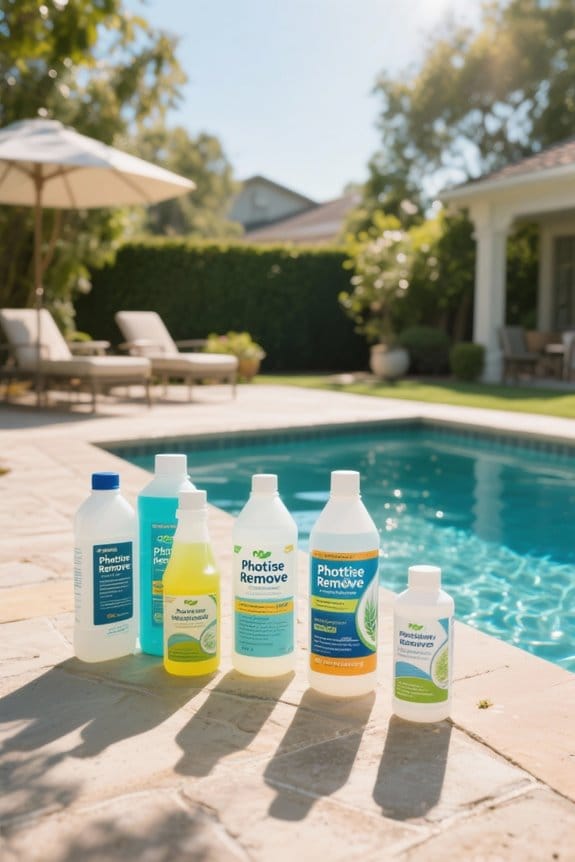
10 Best Phosphate Removers for Pools of 2026 — Keep Your Water Crystal Clear

Measure your pool volume in gallons, grab a LaMotte phosphate kit, and target under 100 ppb. Use Natural Chemistry Pool Perfect, 250 mL per 10,000 gallons weekly, run pump eight hours. Apply Orenda PR-10000 diluted in five gallons dechlorinated water, broadcast along the perimeter for stubborn spikes. Drop FROG 90-Day pods in skimmer monthly for low-maintenance control. Check filter pressure, rinse cartridge if cloudiness appears, and continue to learn product comparisons and troubleshooting tips now.
Key Takeaways
- Top phosphate removers for 2026 include Natural Chemistry Pool Perfect + Phosfree, Orenda PR-10000, FROG 90-Day Goodbye Phos, Summerbuddy, and In The Swim No Phos.
- Choose product by pool size, type (vinyl, fiberglass, concrete, salt), and desired application frequency (weekly, monthly, or single-dose).
- Follow manufacturer dosages precisely—typical rates: 250 mL or 4 oz per 10,000 gallons, or one prefilled pod per month.
- Monitor phosphate and filter performance after treatment; expect brief cloudiness and increased filter backwashing or cleaning.
- Prioritize safety: use PPE, dilute concentrates when required, confirm SDS/NSF info, and document doses in a treatment log.
Natural Chemistry® Pool Perfect® + Phosfree®, 3-Liter (2-Pack)

Natural Chemistry Pool Perfect + Phosfree, 3 L, 2 Pack, Phosphate Remover, Reduces Waterline Rings...
- Dual Action Treatment: Natural Chemistry's Pool Perfect + Phosfree provides pool owners with an effective dual-action treatment to help remove phosphates, and use natural...
- Broad Spectrum Enzymes: Pool Perfect + Phosfree natural enzymes keep water clear of non-living organic materials, simplifying overall pool maintenance by increasing the...
- Easy Pool Maintenance: The benefits of our SMARTZyme technology combined with our phosphate removal provides superior water quality with less work. Pool Perfect...
You may be interested
Use Natural Chemistry Pool Perfect + Phosfree, the 3-Liter two-pack, when you need weekly phosphate control. Measure 250 mL per 10,000 gallons, pour into skimmer, run pump 8 hours. Test phosphates with a calibrated phosphate test kit before dosing, record values, compare to target near-zero. Clean cartridge filter with backwash or manual-clean, inspect for oil residue, replace media if clogged. Apply weekly, combine Pool Perfect and Phosfree to reduce surface oils and non-living organics effectively. Expect reduced filter cleaning, SMARTZyme technology breaks down organics, monitor pressure gauge for 5 to 8 psi increase. Document results, store safely, wear PPE.
Best For: Home and commercial pool owners who want weekly phosphate control, reduced surface oils and organics, and less frequent filter cleaning with SMARTZyme-enhanced treatment.
Pros:
- Maintains near-zero phosphate levels with a simple weekly dose (250 mL per 10,000 gallons).
- Reduces surface oils, non-living organics, and waterline buildup while improving filter performance.
- SMARTZyme technology helps break down organics and can decrease how often you need to clean or backwash filters.
Cons:
- Requires weekly application and regular phosphate testing with a calibrated kit to track results.
- Involves handling chemicals (PPE, safe storage) and routine filter inspection/cleaning; may require media replacement if clogged.
- Not a sanitizer — must be used alongside proper chlorine/bromine or other sanitizing routines.
Orenda PR-10000 Pool and Spa Phosphate Remover Concentrate (1/2 Pint)
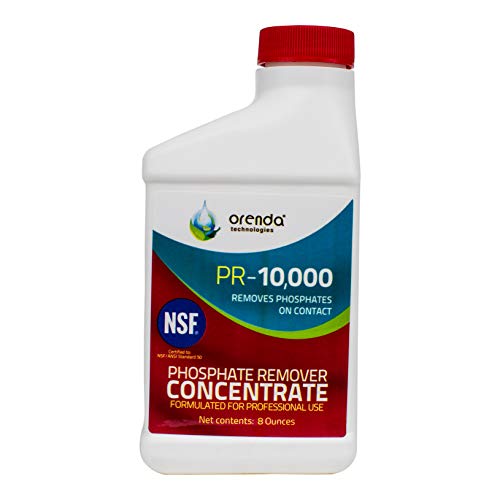
Orenda PR-10000 Removes Phosphates On Contact, Pool and Spa Phosphate Remover Concentrate, 1/2 Pint
- Reacts with phosphates on contact and removes them from solution for vacuuming/filtration
- NSF-Certified as nontoxic, nonhazardous
- Phosphate remover concentrate formulated for professional use
Choose Orenda PR-10000 when you’re a pool professional battling recurring phosphate spikes, it’s a concentrated 1/2 pint formulation that reacts on contact and binds phosphates for vacuuming or filtration. Measure 1/2 pint. Dilute in a clean bucket, use 5 gallons of dechlorinated water, stir with a plastic paddle for uniform solution. Wear goggles. Broadcast slowly along pool perimeter, run pump and filter, maintain turnover for 8–12 hours while monitoring levels. Vacuum or backwash. If phosphates persist, repeat treatment using two applications spaced 24 hours apart, check skimmer and pump baskets for debris. Store sealed, NSF-certified, nonhazardous product, label clearly.
Best For: Pool and spa professionals managing recurring phosphate spikes and improving algae control and water quality.
Pros:
- NSF-certified, nontoxic formulation that lowers chlorine demand and reduces algae food supply.
- Highly concentrated 1/2 pint that reacts on contact and binds phosphates for vacuuming or filtration.
- Improves water quality and supports more effective sanitizer performance.
Cons:
- Intended for professional use — dosing and application require experience and care.
- Requires dilution, pump/filter operation and possible repeat treatments (may need two applications 24 hours apart).
- Requires safety precautions (goggles) and proper handling/storage despite being nonhazardous.
FROG 90-Day Goodbye Phos Phosphate Remover for Pools (3 Pods)
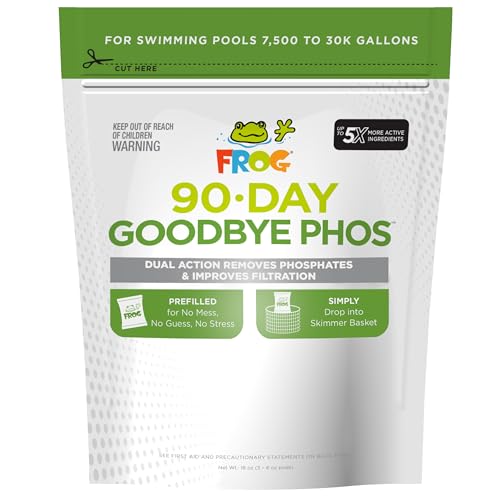
FROG 90-Day Goodbye Phos - Dry Formula Phosphate Remover for Pools up to 30,000 Gallons - Pool...
- No-Phos Pool Chemical: FROG 90-Day Goodbye Phos effectively removes phosphates from swimming pools with prefilled Drop ‘n Go pods; dry, concentrated pool chemicals keep...
- Easy Pool Phosphate Remover: Simply drop a pod in the skimmer, wait 24 hours as it dispenses and discard the used pod when you empty the skimmer
- 90-Day Coverage for Large Pools: This no-phos pool chemical is designed for in-ground or above-ground pools 7,500 to 30,000 gallons; includes 3 pods, use one pod per...
Pool owners managing summer algae risk in in-ground or above-ground pools up to 30,000 gallons will find these prefilled Drop ’n Go pods ideal for hassle-free phosphate control.
Drop a pod into the skimmer.
Wait 24 hours, monitor pump circulation at 1,200–3,000 GPH, then remove and discard the used pod.
Repeat monthly, one pod per month for a 90-day cycle.
Rinse hands after handling, wear nitrile gloves if you have sensitive skin.
Measure phosphates with an electronic kit or strip, target below 125 ppb.
If algae persists, shock with calcium hypochlorite, check filter pressure, backwash as needed, and inspect.
Best For: Pool owners with in-ground or above-ground pools up to 30,000 gallons who want a simple, low‑mess monthly treatment to control phosphates and reduce algae risk.
Pros:
- Prefilled Drop ’n Go pods require no measuring or spills for quick, hassle-free monthly use.
- 90‑day supply (one pod per month) provides ongoing phosphate control to help prevent algae growth.
- Compatible with common pool systems and backed by FROG’s long experience in water care.
Cons:
- Effective only for phosphate removal—won’t replace shock or sanitizer treatments if algae is already present.
- Limited to pools up to 30,000 gallons; larger pools will need additional treatment or product.
- Requires handling/disposal and can cause skin sensitivity (rinse hands after use; wear nitrile gloves if needed).
Pool Phosphate Remover for Swimming Pools
Sale


SUMMERBUDDY Pool Phosphate Remover,Advanced Phosphate Removal Pool Formula-Perfect for Swimming Pool...
- Advanced Rapid-Action Formula: Summerbuddy is specially formulated to address phosphate problems in swimming pools. It quickly treats the source of phosphates, reducing...
- Simple to Apply: All you need to do is apply the product evenly to the surface of the pool and start the circulation system. No complicated techniques or specialized...
- Convenient Maintenance: Summerbuddy Pool Phosphate Remover effectively controls growth by lowering phosphate levels, preventing unwanted organisms. With just one...
Identify whether you manage an in-ground, above-ground, or saltwater pool, and prepare accordingly. Measure phosphate levels with a digital photometer, aim below 100 ppb. Use Summerbuddy Pool Phosphate Remover, dose 4 oz per 10,000 gallons, wear gloves and goggles, have pump at 1.5-2.0 HP running. Broadcast evenly across surface, activate circulation immediately. Expect brief cloudiness as chelated phosphates bind, check cartridge or DE filter, backwash if pressure rises above 10 psi. Retest after 24 hours with the photometer. Repeat 2 oz per 10,000 gallons if levels exceed 100 ppb, increase filtration to 12 hours. Safe for liners, pumps, and salt systems.
Best For: pool owners (in-ground, above-ground, or saltwater) who need a fast, easy way to lower phosphate levels and improve water clarity.
Pros:
- Rapid-action formula that effectively removes phosphates and helps prevent cloudiness.
- Easy broadcast application and compatible with all pool types, liners, filters, and salt systems.
- No foaming or residue; filtration restores clarity quickly with standard maintenance.
Cons:
- May cause brief cloudiness as chelated phosphates are removed, requiring filtration time.
- May require repeat dosing and extended filtration (or backwashing) if levels remain above 100 ppb.
- Requires PPE (gloves and goggles), pump operation at recommended capacity, and monitoring filter pressure.
In The Swim No Phos Phosphate Remover (3 Liter)
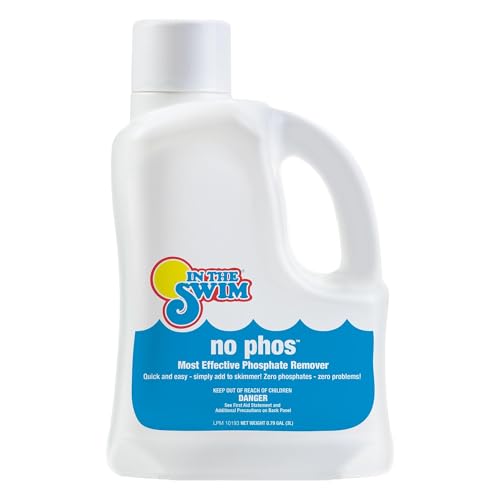
In The Swim - No Phos - Fast-Acting Phosphate Remover for Clear, Balanced Water - 3 Liter
- High-Performance Control: Rapidly removes phosphates that contribute to non-living matter growth and water cloudiness.
- Fast-Acting Strength: Delivers 20% more power than leading phosphate removers with a clear, non-clouding lanthanum-based formula that works immediately.
- Lanthanum Technology: Binds phosphates to your pool filter for easy and effective elimination.
Use In The Swim No Phos when you need a fast, no-mix lanthanum-based phosphate remover in a 3-liter bottle. Measure pool volume, record phosphate ppm, prepare a pH test kit, and have a skimmer basket clear of debris. Pour 250 mL per 10,000 gallons through the skimmer slowly. Run the pump for four hours, backwash filter if pressure rises above 8 psi over baseline, retest phosphates. Use a cartridge, DE, or sand filter based on system type. If cloudiness persists after 24 hours, add an additional 125 mL per 10,000 gallons, monitor filter media closely. Contact support for troubleshooting.
Best For: Home and commercial pool owners/operators who need a fast, no-mix lanthanum-based phosphate remover to quickly reduce phosphates and restore water clarity after storms, cleanups, or chemical treatments.
Pros:
- Rapid, no-mix liquid formula that is poured into the skimmer and works immediately.
- Lanthanum-based action binds phosphates to the filter for effective removal.
- Claims 20% more power than leading phosphate removers and is suitable for cartridge, DE, or sand filter systems.
Cons:
- Requires running the pump for hours and close monitoring of filter pressure (may need backwashing if pressure rises).
- Cloudiness can persist, necessitating a follow-up dose and additional filter attention.
- Effectiveness depends on proper skimmer/filter condition and may be less convenient if skimmer basket or filtration isn’t prepared.
AquaDoc Pool Phosphate Remover (64 oz)
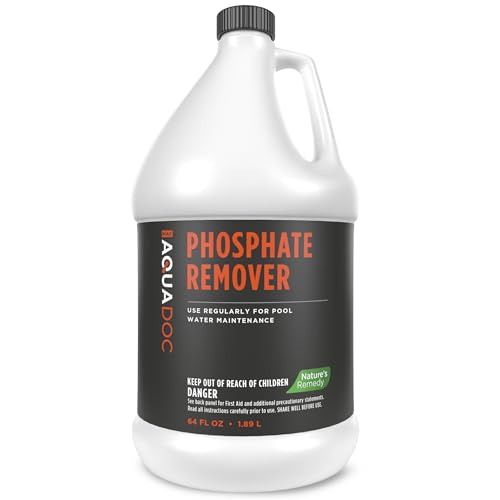
AquaDoc Pool Phosphate Remover - 64 oz - Concentrated Phosphate Remover for Pool Opening...
- Concentrated Phosphate Remover for Pools - AquaDoc's Pool Phosphate Remover works to help reduce phosphate levels, resulting in clearer pool water and easier maintenance...
- Great for Pool Opening & Maintenance - Ideal for spring startup and ongoing pool care, it helps bind phosphates in the water so they can be captured by your pool filter...
- Helps Reduce Phosphate Buildup - Phosphates can build up over time from debris, rainwater, and swimmer use. Use regularly to help reduce phosphate buildup as part of your...
Choose AquaDoc when you need fast, maximum-strength phosphate removal for seasonal openings, the 64 oz bottle treats multiple shock cycles. Measure 64 oz capacity, dose 1–2 oz per 10,000 gallons for weekly maintenance, use a calibrated measuring cup and nitrile gloves. Pre-test phosphate with a digital meter or test kit, balance pH to 7.2–7.6, then broadcast solution while pump runs at 1,500+ GPH. For high readings, double the initial dose, retest after 24 hours, brush surfaces and vacuum debris. Compatible with salt and chlorine pools, suitable for in-ground and above-ground equipment. Replace every season or when clarity noticeably declines.
Best For: Pool owners who need a fast, maximum-strength phosphate remover for seasonal openings and ongoing weekly maintenance across saltwater or chlorine, in-ground or above-ground pools.
Pros:
- Fast-acting, maximum-strength formula that quickly knocks out phosphates for improved clarity.
- Universal compatibility with salt and chlorine systems and both in-ground and above-ground pools.
- 64 oz bottle treats multiple shock cycles and supports low weekly dosing (1–2 oz per 10,000 gallons).
Cons:
- Requires pre-testing, pH balancing, and precise dosing (measuring cup and pump flow) for best results.
- Chemical handling precautions (use nitrile gloves) and possible need to double dose for very high phosphate levels.
- Not a permanent fix—product should be replaced each season or when clarity noticeably declines.
Natural Chemistry Phosfree, 3-Liter

Natural Chemistry Phosfree Phosphate Remover, 3 Liter, Single Pack
- Reduces Phosphates: Natural Chemistry's Phosfree enables pool owners to drop phosphate levels in your pool to almost nothing.
- Clear Water: PHOSfree works in the filter to minimize any water clouding, ensuring the water stays sparkling clear.
- No Phosphates, No Problem: PHOSfree is formulated from lanthanum (rare earth) compounds. When added to your skimmer, a thin coating of PHOSfree forms on the filter media...
For pool owners dealing with recurring algae blooms, the Natural Chemistry Phosfree 3-Liter is ideal, reducing phosphates to near zero. Measure 1 liter per 10,000 gallons immediately. Pour into the skimmer while pump runs, run filter for 24 hours, and repeat weekly. Use a phosphate test kit to confirm near-zero readings. If cloudiness appears, backwash a sand filter or chemically clean cartridge elements, repeat dosing at reduced rate. Expect little to no effect on pH and chlorine demand, typically. Rely on lanthanum-based action, coat filter media thoroughly via skimmer feed, troubleshoot by checking flow, pump pressure, and filter differential.
Best For: Pool owners struggling with recurring algae blooms or high phosphate levels who want a filter-applied, lanthanum-based treatment to lower phosphates to near zero.
Pros:
- Effectively reduces phosphates to near zero, helping prevent algae growth.
- Works through the filter without noticeably clouding pool water when used correctly.
- Typically causes little to no effect on pH or chlorine demand and can reduce overall maintenance.
Cons:
- Requires correct dosing (1 L per 10,000 gallons) and weekly repeats until levels are confirmed near zero.
- May cause temporary cloudiness if not filtered/backwashed or if cartridge elements need chemical cleaning.
- Dependent on proper filter flow and operation—ineffective if pump/filter issues or poor circulation exist.
Natural Chemistry Pool Perfect + Phosfree, 3-Liter (1-Pack)
Sale

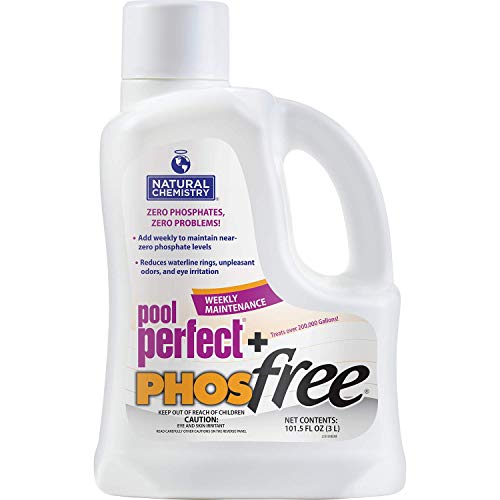
Natural Chemistry Pool Perfect + Phosfree, 3 Liter, Single Pack
- Dual Action Treatment: Natural Chemistry's Pool Perfect + Phosfree provides pool owners with an effective dual-action treatment to help remove phosphates, and use natural...
- Broad Spectrum Enzymes: Pool Perfect + Phosfree natural enzymes keep water clear of non-living organic materials, simplifying overall pool maintenance by increasing the...
- Easy Pool Maintenance: The benefits of our SMARTZyme technology combined with our phosphate removal provides superior water quality with less work. Pool Perfect...

Inspect your pool chemistry and equipment before adding any treatment. Measure phosphate with a handheld test kit, record ppb, check pH, chlorine, note filter pressure. Dilute and dose weekly. Use the 3-liter Natural Chemistry Pool Perfect + Phosfree pack, follow label dosage per 10,000 gallons. Run pump eight to twelve hours after dosing. Rely on SMARTZyme technology to reduce filter cleanings, scrub scum line less often, and improve clarity. If phosphate remains, shock and retest. Inspect cartridge or DE filter, backwash when pressure rises eight to ten psi over baseline, replace media. Expect near zero ppb with consistent use.
Best For: Home pool owners who want to reduce phosphates and improve water clarity with a weekly additive that eases filter cleaning and scum-line maintenance.
Pros:
- Helps maintain near-zero phosphate levels with weekly dosing, improving water quality and clarity.
- SMARTZyme technology reduces frequency of filter cleanings and scum-line scrubbing.
- Cleans waterline and filter, streamlining routine pool maintenance.
Cons:
- Requires regular weekly dosing and phosphate testing (and possible shocking) to be effective.
- Not a sanitizer—does not replace chlorine or other primary disinfectants.
- May still require filter backwashing/media replacement and running the pump 8–12 hours after dosing, adding time and cost.
AquaDoc Phosphate Remover for Saltwater Pools (32 oz)

AquaDoc Saltwater Pool Phosphate Remover - 32 oz - Concentrated Phosphate Remover for Pool Opening...
- Concentrated Phosphate Remover for Saltwater Pools - AquaDoc's phosphate remover for pool is made for saltwater pools to help reduce phosphate levels and support clearer...
- Great for Pool Opening & Maintenance - Ideal for spring startup and ongoing saltwater pool care, it helps bind phosphates in the water so they can be captured by your...
- Helps Reduce Phosphate Buildup - Phosphates can build up over time from debris, rainwater, and swimmer use. Use regularly to help reduce phosphate buildup as part of your...
Measure phosphates, then apply AquaDoc’s 32 oz treatment if you’re running a saltwater chlorinator. Test with a reliable phosphate kit, record ppb, aim below 200 ppb before treatment. Dose precisely, pour 32 oz per 10,000 gallons for reduction, adjust for volume. Run pump and filter 24 to 48 hours, use sand or cartridge filter, backwash if pressure rises. Monitor clarity, retest phosphates after 48 hours, expect significant drop with proper filtration. Troubleshoot stubborn phosphates, check calcium hardness and organic load, repeat dosing at half-strength if needed. Maintain routine, integrate monthly testing, document doses and filter cycles to prevent recurrence.
Best For: Saltwater pool owners who regularly monitor phosphate levels and want an easy-to-use treatment to improve clarity and reduce nutrient buildup.
Pros:
- Designed specifically for saltwater pools and works through the filtration system for easy removal.
- Simple dosing (32 oz per 10,000 gallons) with clear pump/filter run guidance for predictable results.
- Made in the USA, formulated to support routine pool maintenance and clearer water.
Cons:
- Requires accurate phosphate testing and volume calculations to dose correctly.
- Needs 24–48 hours of pump/filter operation (and possible backwashing) to be effective.
- Stubborn phosphate problems may require repeat or half-strength dosing and addressing underlying issues (calcium hardness, organics).
Clorox Pool&Spa ClearPHOS Water Clarifier and Phosphate Remover (1 Quart)
Sale


Clorox® Pool&Spa™ Swimming Pool ClearPHOS Water Clarifier and Phosphate Remover, 1 Quart (Pack of...
- Phosphate Remover: This product controls phosphate (algae food) to reduce overall maintenance. It’s formulated to remove phosphates and consistently remove phosphates...
- Clears Cloudy Water: ClearPHOS effectively clears excessively cloudy water and restores sparkle to your pool water. It also helps filter small dirt particles that cause...
- Prevents Waterlines: ClearPHOS Water Clarifier and Phosphate Remover reduces maintenance by helping keep the waterline clear.
Choose the 1-quart Clorox Pool&Spa ClearPHOS when you manage residential or commercial pools that suffer recurring phosphate-driven algae and persistent cloudiness. Measure dosage carefully. Apply one ounce per 2,500 gallons, pour along perimeter, operate pump six hours, mix. Test phosphates weekly. Use the Clorox Pool App for guidance, record levels, adjust dose above 100 ppb, clean cartridge filters if clogged. Address cloudy returns immediately. If cloudiness persists, check skimmer baskets, backwash DE or sand filters, test for contaminants, repeat weekly until below 50 ppb. Store bottle upright, label date applied, wear nitrile gloves, contact Clorox support for adverse reactions.
Best For: Residential and commercial pool owners/operators dealing with recurring phosphate-driven algae and persistent cloudy water who can perform weekly testing and dosing.
Pros:
- Controls phosphates (algae food) to reduce algae growth and overall maintenance.
- Clears cloudy water by helping filter out small dirt particles and restoring sparkle.
- Simple weekly dosing (1 oz per 2,500 gallons) with guidance from the Clorox Pool App for testing and adjustments.
Cons:
- Requires regular weekly testing and repeat applications to keep phosphate levels low.
- May not resolve cloudiness alone if filters, skimmer baskets, or other contaminants need cleaning/backwashing.
- Requires careful handling and storage (gloves, upright bottle, labeling) and is specific to phosphate-related problems.
Factors to Consider When Choosing Phosphate Remover for Pool
Inspect pool type, record surface material and filter model, prioritize compatibility before you apply any treatment. Use a calibrated test kit, dose about 1 oz per 1,000 gallons, add product with pump circulation for two hours, then re-test and adjust pH to 7.2–7.6 if readings shift. Verify active ingredient type, confirm NSF/ANSI or EPA certification, wear gloves and goggles, and troubleshoot persistent phosphates with a clarifier or repeat dosing as needed.
Pool Type Compatibility
Because pool materials and systems differ, confirm phosphate remover compatibility with in-ground, above-ground, vinyl liners, fiberglass, and concrete pools. Read the product label. Check saltwater-safe formulas if you have a salt chlorine generator, measure salinity, and note ppm ranges. Verify filter compatibility. Confirm performance with cartridge, sand, or DE filters, follow dosing charts—use 4 oz per 10,000 gallons as guideline. Protect vinyl liners. Avoid phosphate removers with harsh coagulants if label warns, test a 1-liter patch, observe 24-hour clarity and material response. Use appropriate PPE. When troubleshooting cloudy water after treatment, run pump 8–12 hours, backwash sand filters, then retest at 24 hours. Consult manufacturer support. Contact technical support with pool type, filter model, test kit readings, sample photos for dosing and safety advice.
Removal Speed and Efficacy
After confirming filter and material compatibility, focus on removal speed and efficacy before treating your pool. Test phosphate levels immediately. Choose a rapid-action product, note dosing of 8 to 16 ounces per 10,000 gallons, use a calibrated, chemical-resistant measuring cup. Circulate for at least 8 hours. Monitor with a digital phosphate meter or test kit every 6 to 12 hours, record readings for troubleshooting. Expect clarity within 24 hours. If levels remain high, backwash or clean cartridge/DE filters, inspect pump flow, repeat half-dose application after 24 hours. Maintain monthly maintenance dosing to prevent phosphate rebound. Select enhanced formulations when immediate binding is needed, verify instructions for dosage and filtration removal rates. Consult manufacturer technical data sheets and MSDS for precise dosing and safety guidance.
Active Ingredient Type
Active ingredient choice matters.
Check product type.
Prefer lanthanum-based compounds for phosphate binding, measure dosage per 10,000 gallons, prepare a dosing pump or bucket.
Consider SMARTZyme options.
Use SMARTZyme formulations to reduce filter cleanings, follow manufacturer ppm targets, monitor with a phosphate test kit.
Choose concentration wisely.
Select professional-grade concentrates for rapid removal, calculate dose by pool volume in gallons, wear nitrile gloves and goggles.
Expect troubleshooting steps.
If clouding occurs, backwash the filter, retest phosphates after 24 hours, repeat treatment at half-dose if needed.
Validate non-toxic claims.
Confirm formulations are nonhazardous for swimmers and aquatic life, review technical data sheet, keep chlorine stable during treatment.
Document your dosing.
Record date, gallons treated, product name, batch, phosphate readings before and after, adjust future maintenance schedule.
Safety and Certifications
When choosing a phosphate remover, check for NSF certification and a clear SDS before purchasing. Inspect label. Verify non-toxic, nonhazardous formulation claims, review independent efficacy data, and confirm pool material compatibility, check filter-residue reports. Read the SDS. Use a chlorine meter, pH probe, and turbidity tube to monitor changes after treatment, document each 24-hour reading. Avoid products that leave residues. If you see liner discoloration or filter clogging, stop dosing, backwash the filter, collect samples, and contact manufacturer support. Prefer certified, independently tested brands. Confirm dosing instructions match pool volume, calculate liters or gallons precisely, and record batch numbers for traceability, include lot date. Keep records. Prioritize products with ISO or third-party lab reports, retain certificates in your maintenance log for audits, warranty claims.
Application Ease and Dosage
If you want minimal hassle, pick products with prefilled pods or no-mix formulas and follow the label; they remove spill risk and simplify dosing. Choose weekly dosages, measure in ounces per 10,000 gallons, note labels recommending 4-8 oz. Apply directly to skimmer or pour along deep end, use measuring cup and gloves. For monthly options, dose 16–32 oz per 20,000 gallons, run pump 8–12 hours, test phosphates after 24 hours then retest at seven days. Expect rapid action formulas to drop levels within 24 hours, if not, check pH, alkalinity, and filtration. Troubleshoot by flushing skimmer basket, backwashing DE or cartridge cleaning, adjust dose down if cloudiness appears, document measurements with log book. Keep safety goggles, respirator, and storage label visible, follow disposal instructions precisely.
Frequently Asked Questions
Are Phosphate Removers Safe for Pool Plants and Wildlife if Accidentally Released?
Yes, they’re safe when you dilute, contain them, but act cautiously. Wear nitrile gloves and goggles, measure spills with a 100 mL cylinder, dilute with fresh water, block runoff. Avoid releasing into ponds, streams, or wetlands, near wildlife. If release occurs, deploy spill kit with pads, pH strips, contain and recover within 30 minutes. Notify authorities if uncontrolled, test dissolved oxygen with a probe, aerate with battery pumps, document, photograph.
How Should I Dispose of Unused Phosphate Remover Chemicals Safely?
Take unused remover to local hazardous waste facility.
Wear chemical-resistant gloves, eye protection, and a respirator, seal product in original container with label securely tape.
Transport it in a leakproof secondary container, upright.
Call your municipality or waste pickup number, schedule a hazardous pickup, or find a state-approved drop-off site.
Don’t pour into storm drains or soil nearby.
For spills, absorb with cat litter, bag it, call local emergency number.
Will Phosphate Removers Interfere With Enzyme-Based Pool Treatments?
Expect interference, especially if removers precipitate metal cofactors like manganese ions.
Measure enzyme dosage, record product SDS, test phosphate removal on a 1-liter sample before treating entire pool surface.
Run a bench assay, add enzyme after clarifier removal has settled.
If activity drops over 20 percent, dilute phosphate remover, re-dose enzymes at manufacturer rates, don’t delay monitoring daily.
If precipitation occurs, backwash filter, vacuum, and repeat assay before full-scale treatment.
How Quickly Will Phosphate Levels Rebound After Treatment and Require Retesting?
Phosphate pulse: expect rebound in two to four weeks. Test weekly. Use a handheld colorimeter or DPD test kit, measure to 0.1 ppm precision, log results. You must treat quickly if levels exceed 0.5 ppm. Shock flocculant filters, or phosphate remover at manufacturer dosage, use pump, cartridge filter, monitor flow rate. Inspect sources, don’t delay. Check runoff, backwash frequency, swimmer contamination, reapply treatment after heavy rain or turf fertilization events.
Do Phosphate Removers Alter Pool Ph or Require Additional Balancing?
You usually won’t see pH change, but monitor anyway daily. Test pH with a calibrated DPD or glass electrode meter, record initial pH and free chlorine now. Apply per label, one to two ounces per 10,000 gallons. If pH drifts beyond 0.2, adjust with sodium bisulfate or soda ash, add slowly retest 30 minutes. Run pump for two to four hours, promote contact continually. Backwash DE or clean cartridge, repeat.