As an Amazon Associate, we earn from qualifying purchases. Some links on this site are affiliate links at no extra cost to you. Our recommendations are based on thorough research and editorial judgment.

3 Best Saltwater Test Strips for Your Pool: Accurate Readings for Crystal Clear Water

To maintain crystal clear water in your saltwater pool, use the 8-Way Pool Salt Test Strips Kit. Test hardness, bromine, pH, and salt levels twice a week for ideal results. For thorough testing, opt for the 9 in 1 Testing Kit, which checks multiple parameters weekly in summer. If sodium chloride is your focus, the Saltwater Pool Test Strips Kit is perfect. Follow storage recommendations for accuracy. Keep reading to discover vital factors for choosing the right test strips.
Key Takeaways
- The 8-Way Pool Salt Test Strips Kit is perfect for pool and spa owners, checking hardness, bromine, pH, and salt levels effectively.
- The 9 in 1 Testing Kit offers comprehensive monitoring of salt, pH, chlorine, and copper, making it ideal for diverse saltwater applications.
- For precise sodium chloride measurements, the Sodium Chloride Test Strips Kit is specifically designed for accurate readings essential for saltwater pools.
- Regular testing—twice a week for the 8-Way Kit and weekly in summer for the 9 in 1—is crucial for maintaining optimal water quality.
- Always follow best practices for storage and testing conditions to ensure reliable results and extend the shelf life of your test strips.
Pool Salt Test Strips – 8-Way Testing Kit for Swimming Pools and Spas
Sale

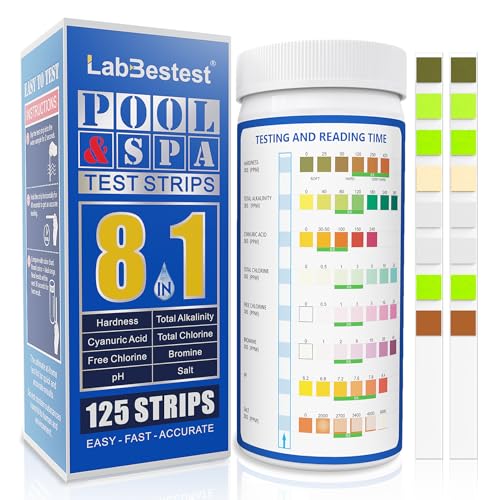
LabBestest Pool Salt Test Strips - Salt Water Pool Testing Kit - 125 Saltwater Pool Spa Hot Tub Test...
- 8-Way Professional Salt Pool Test Strips Kit - LabBestest No Lab Visit. Get Lab-Accurate Result. LabBestest has many quality certificates such as CE, ISO. This test kit...
- 125 Premium Home Test Strips Value Pack - Our Salt Water Pool Testing Kit Contains 125 Salt Pool Test Strips. Enough balanced for your saltwater pool, spa, hot tub, and...
- Upgraded Technology Easy Rapid Accurate Testing - Our test strip is easy to use, with just 3 steps to get lab-grade accurate results in 30 seconds. Our test strips use...
You may be interested
For pool owners and spa enthusiasts looking for a reliable solution to monitor water quality, the 8-Way Pool Salt Test Strips Kit is an excellent choice. This kit tests essential parameters like hardness, bromine, pH, and salt. To guarantee your pool or spa stays in top shape, test the water at least twice a week. Dip a strip into your water for precisely two seconds, remove it, and wait 30 seconds. Match the color to the chart on the container for results. Store your strips in a cool, dry place, and keep the container sealed. For any questions, contact customer support.
Best For: Pool owners and spa enthusiasts seeking a reliable and easy-to-use solution for monitoring water quality.
Pros:
- High Accuracy: Utilizes sensitive materials to provide lab-grade accurate results.
- Comprehensive Testing: Tests multiple parameters including hardness, bromine, pH, and salt, ensuring thorough maintenance of water quality.
- User-Friendly: Simple three-step procedure for obtaining results in just 30 seconds.
Cons:
- Limited to Salt Water: Specifically designed for salt water pools, may not be suitable for traditional chlorine pools.
- Requires Frequent Testing: Recommended testing frequency of twice a week may be cumbersome for some users.
- Storage Sensitivity: Needs to be stored in a cool, dry place and kept sealed to maintain effectiveness.
Pool Salt Test Strips 9 in 1 Testing Kit for Saltwater Pools
Sale

2026 New Pool Test Strips - 9 in 1 Pool Salt Test Strips 150 Counts for Salt Water Pool Testing Kit...
- 9-in-1 Pool Test Strips for Salt Water Pool: Our saltwater test strips provide an all-in-one solution for both chlorine & saltwater pool maintenance, testing salt...
- Quick & Accurate Results: Simply dip the salt test strips into your saltwater pool, spa, or chlorine pool water, and compare the color changes to the included chart for...
- Reliable & High-Quality Testing for Pool Health: Crafted for dependability, our 9-in-1 saltwater pool test kit are made from high-quality materials to provide accurate...
The Pool Salt Test Strips 9 in 1 Testing Kit is your go-to solution for maintaining excellent water quality in saltwater pools. Start by taking a strip from the pack, then dip it into your pool water for about 2 seconds. Remove and wait for 30 seconds to observe any color changes. Compare the results against the included chart, ensuring you check levels for salt, pH, chlorine, and copper, among others. Perform these tests regularly—aim for weekly checks in summer. For best results, store unused strips in a cool, dry place and use them within 90 days after opening.
Best For: This product is best for pool owners who want a reliable and comprehensive solution for maintaining optimal water quality in saltwater pools, inground pools, spas, and hot tubs.
Pros:
- Quick and easy testing with immediate color comparison for accurate results.
- Comprehensive 9-in-1 testing for key parameters including salt, pH, chlorine, and copper.
- Ideal for year-round maintenance with a long shelf life of 2 years when stored properly.
Cons:
- Limited effectiveness if not used within 90 days after opening for optimal accuracy.
- Requires regular testing, which may be time-consuming for some users.
- Color chart interpretation might be challenging for users with color vision deficiencies.
Saltwater Pool Test Strips Kit for Sodium Chloride Content (25 Count)
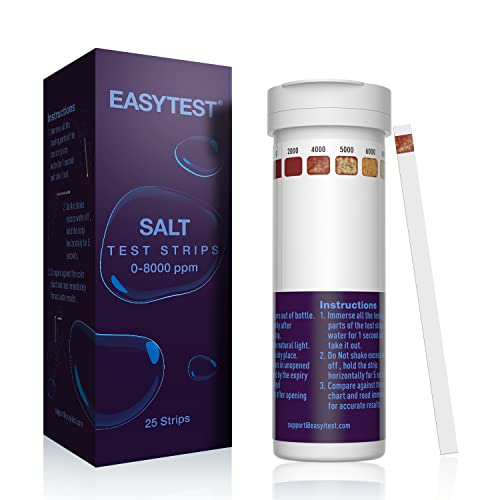
EASYTEST Saltwater Pool Test Strips, 0-8000 ppm, 25 Count
- WHAT IS SALTWATER POOL : Saltwater pools are some pools which can create chlorine by adding salt in the pool water. Swimming in a saltwater may be better for someone who...
- WHY MEASURE SALT IN THE POOL: Most saltwater pool require a salt content of 1,500–4,500 ppm as sodium chloride (NaCl) in the swimming pool. If the salt concentration is...
- FAST TO TEST SALT FOR POOL: Immerse all the testing parts of the test strip into water for 1 second and take it out;Do Not shake excess water off , hold the strip...
When maintaining a saltwater pool, using the right test strips is essential for accurate sodium chloride measurement. Grab your Saltwater Pool Test Strips Kit with 25 count strips. Immerse a test strip in your pool water for exactly one second, then hold it horizontally for five seconds. Don’t shake off excess water; this could alter results. Immediately compare the strip’s color against the provided chart. Aim for a salt level around 3200 ppm. For best accuracy, avoid touching the strips with wet fingers, check results in natural light, and use the strips soon after opening to guarantee maximum effectiveness.
Best For: Individuals maintaining saltwater pools, swimming pools, or hot tubs who need precise sodium chloride measurements.
Pros:
- High-quality PET paper provides reliable and instant results.
- Specifically designed for accurate testing in saltwater environments.
- Easy-to-follow testing method ensures quick and efficient results.
Cons:
- Limited to measuring only sodium chloride content.
- Results must be interpreted immediately after testing, which may be inconvenient.
- Effectiveness decreases after opening; should be used soon for best results.
Factors to Consider When Choosing Saltwater Test Strips for Pool
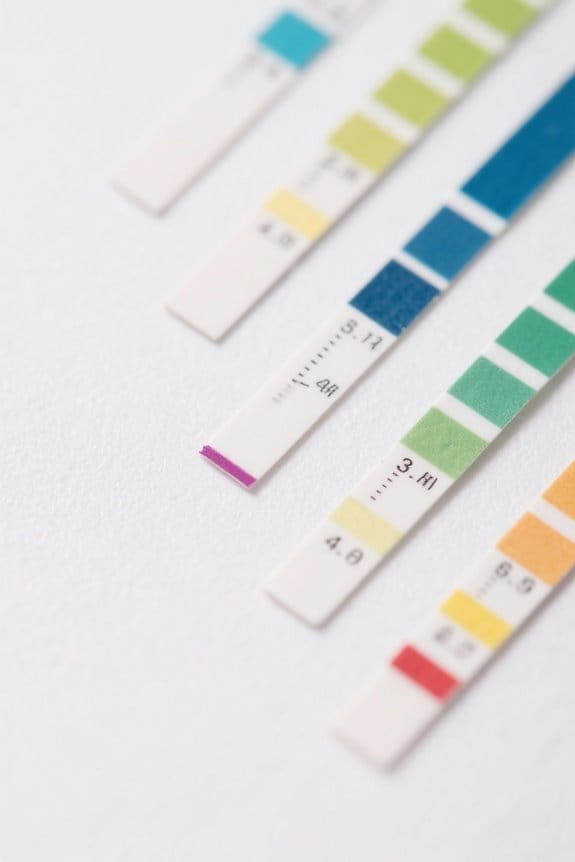
When selecting saltwater test strips, pay attention to several key factors. Evaluate the testing parameters offered, such as sodium chloride and pH levels, to guarantee they meet your pool’s requirements. Check the quality and durability of the strips, consider the intended pool types, and assess how easy it is to interpret results, along with their storage and shelf life.
Testing Parameters Offered
To guarantee you choose the best saltwater test strips for your pool, assess the testing parameters they offer. Look for strips that test for essential factors like salt concentration, pH, chlorine levels, alkalinity, and hardness. Consider options with multi-parameter capabilities, such as 8-way or 9-in-1 strips, for a thorough analysis. Don’t forget to check if they test for copper levels, as high copper can harm water quality and swimmer safety. Choose products that deliver results within seconds, helping you manage water balance efficiently. Always opt for test strips made from high-quality materials, ensuring accurate and consistent readings over time. This consistency is key to maintaining ideal water conditions in your saltwater pool.
Strip Quality and Durability
Choosing quality saltwater test strips is as important as understanding the testing parameters. First, check the materials; high-quality strips usually use PET paper for durability and accurate readings. Make certain those strips have at least a two-year shelf life when properly stored. Opt for strips that don’t require shaking after dipping, as this minimizes contamination and improves result consistency. Always select strips that provide instant results, allowing you to easily compare with color charts. Finally, verify that the colors on the strips resist fading or discoloration over time, guaranteeing reliable readings. By following these guidelines, you’ll maintain accurate monitoring of your pool’s saltwater levels for crystal clear water.
Intended Pool Types
While it’s important to maintain your saltwater pool, knowing the type of pool you have influences your choice of test strips. Select strips specifically designed for saltwater pools; they accurately measure sodium chloride levels, necessary for chlorine generation. Consider your pool type—whether it’s a saltwater pool, inground pool, spa, or hot tub—and choose strips suitable for all applications. Verify the strips you pick test key parameters such as pH, total chlorine, alkalinity, and hardness to maintain water quality. Confirm that they function effectively in different seasons; reliable readings are essential for both residential and commercial pools. If you can, choose strips that include copper level testing to help maintain chemical balance and prevent harmful effects.
Result Interpretation Ease
For effective result interpretation of your saltwater test strips, prioritize options that come with a clear color chart. This allows for quick and accurate comparisons, minimizing errors. Select strips that provide readings in under 30 seconds to promote efficient decision-making. Aim for a kit that measures multiple parameters, like pH, total chlorine, and salt levels, ensuring a thorough water quality assessment in one step. Choose test strips with straightforward instructions—this guides you through the testing process, enhancing usability for everyone. Finally, opt for products made from high-quality materials, as they yield consistent results essential for maintaining safe swimming conditions. Regularly verify your results for any discrepancies to maintain ideal pool health.
Storage and Shelf Life
To maintain the accuracy of your saltwater test strips, pay close attention to storage and shelf life. Always store your test strips in a cool, dry place to enhance their longevity. Keep the container tightly closed after each use to prevent moisture exposure, which can compromise their accuracy. Test strips generally have a shelf life of about two years from the manufacturing date, but using them within 90 days of opening is preferable. Avoid touching the strips with wet fingers to eliminate contamination risks that affect results. For the best accuracy, read the results in natural daylight immediately after dipping the strip into the pool water. Following these guidelines will guarantee reliable readings every time.
Frequently Asked Questions
How Often Should I Test My Pool’s Salt Levels?
Test your pool’s salt levels at least twice a month. Use reliable saltwater test strips for accuracy. First, gather your supplies: test strips, a clean container, and water from about 12 inches below the surface. Dip the strip into the sample, then wait the recommended time. Compare the color against the chart. If the salt level’s out of range—usually 2700 to 3400 ppm—adjust using salt or fresh water as needed.
What Do I Do if My Salt Levels Are Too Low?
If your salt levels are too low, add pool-grade salt directly to the water. Start by measuring the current salt level with your test strips, then calculate the required amount of salt. Generally, you’ll need approximately 1 pound of salt for every 1,000 gallons of water to boost levels 100 ppm. Sprinkle the salt evenly across the pool, then run your filter for 24 hours to properly distribute it. Retest afterward for accuracy.
Can I Use Regular Test Strips for Saltwater Pools?
No, you can’t use regular test strips for saltwater pools. Regular strips measure chlorine, pH, and alkalinity, but they don’t accurately gauge salt levels, which are essential for saltwater systems. Instead, purchase saltwater test strips specifically designed for this purpose. Follow the instructions closely; dip the strip in your pool water for the recommended time, compare it to the color chart, and adjust the salt level accordingly using a saltwater system or additives.
Are Saltwater Test Strips Reusable or Single-Use?
Saltwater test strips are typically single-use and shouldn’t be reused. To test your pool, take a strip from the container, ensuring you store the rest in a cool, dry place. Dip the strip into the pool water for about 2 seconds, then wait for the recommended time on the package. Compare the color result to the chart provided to determine your salt levels, and discard the strip after use.
How Should I Store My Test Strips for Accuracy?
To store your test strips accurately, keep them in their original, tightly-sealed container. Avoid exposing them to heat, moisture, or direct sunlight—storing them in a cool, dark place would be ideal. Always check the expiration date on the packaging before use. If you notice any discoloration or damage, discard the strips immediately. For best results, use them promptly after opening, and avoid touching the test pads with your fingers.