As an Amazon Associate, we earn from qualifying purchases. Some links on this site are affiliate links at no extra cost to you. Our recommendations are based on thorough research and editorial judgment.

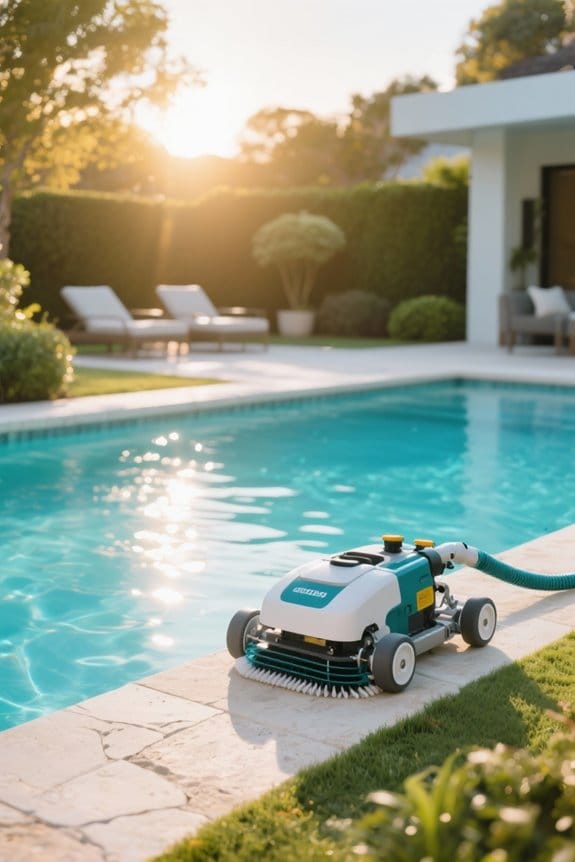
Pool Cleaner Wheels vs. Tracks: Pros & Cons

Evaluate your pool’s incline and shape before choosing wheels or tracks. Use track-based cleaners like Aquabot Turbo T4RC for steep walls up to 90°, heavy debris, and deep scrubbing with rotating brushes; expect higher cost and regular brush maintenance. Opt for wheel-based cleaners for irregular shapes and slopes under 60°, benefiting from energy-efficient jets and lower prices but less aggressive cleaning. Inspect jets, wheels, or tracks routinely to avoid clogs. Discover more on optimizing cleaner choice and pool design compatibility here.
Key Takeaways
- Track-based cleaners provide superior grip and can climb steep inclines up to 90°, outperforming wheel models limited to 60° slopes.
- Wheels offer cost-effective, lightweight solutions ideal for flat, irregular, or small pools with light debris.
- Tracks feature rotating brushes for deep scrubbing, while wheels have non-rotating brushes, affecting cleaning thoroughness.
- Track cleaners reduce filter strain by about 50%, enhancing pool system efficiency and reducing maintenance frequency.
- Wheels provide better maneuverability on irregular pool shapes, but tracks excel on complex designs and tough debris removal.
Track Based Pool Cleaners
You may be interested

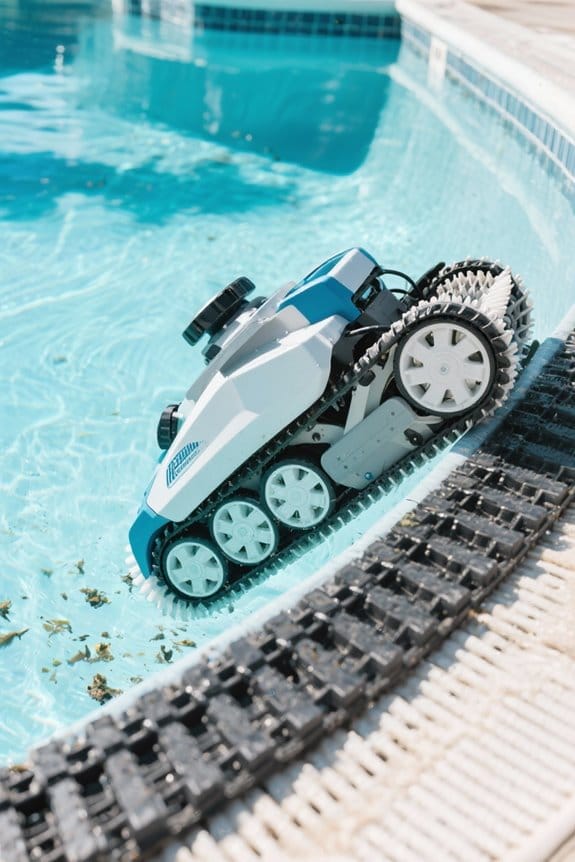
When selecting a track-based pool cleaner, consider models like the Aquabot Turbo T4RC or Dolphin Oasis Z5 for their advanced cleaning technology and reliability. Choose a track-based cleaner for superior grip and enhanced maneuverability across diverse pool surfaces. Engage the rotating brushes to aggressively scrub dirt and debris from floors and walls, then allow the unit to climb walls with up to 90° inclines. Monitor the cleaner’s path to guarantee full coverage, reducing pool filter strain by roughly 50%. Confirm that tracks maintain consistent traction, especially on slopes or uneven areas. Utilize these systems to maintain thorough cleaning of inground pools with varying depths. Regularly inspect for clogged brushes or impaired movement to optimize performance and extend operational lifespan. Additionally, selecting a model with advanced navigation technology can ensure optimized cleaning routes and improved efficiency.
Wheel Based Pool Cleaners
Explore wheel-based pool cleaners as an alternative to track-based models, especially for pools with less steep walls or irregular shapes. Choose wheel-powered robotic pool cleaners that rely on jets for propulsion instead of wheel motors, improving energy efficiency. Verify your pool walls have inclines no greater than 60°, since wheels cannot scale steeper slopes effectively. Inspect the non-rotating brushes on most models to guarantee they sufficiently loosen dirt but note they may provide less scrubbing force than track-based cleaners. Prioritize models with durable wheels to reduce wear and extend lifespan, particularly for irregular or bowl-shaped pools where maneuverability is essential. Budget accordingly, as wheel-based pool cleaners generally cost less than track variants. Adjust settings to optimize cleaning paths, and regularly check jets and wheels for clogs or damage to maintain performance. Additionally, ensuring proper filtration by choosing vacuum bags with filtration efficiency can enhance the overall cleaning experience.
Key Differences Between Wheels and Tracks
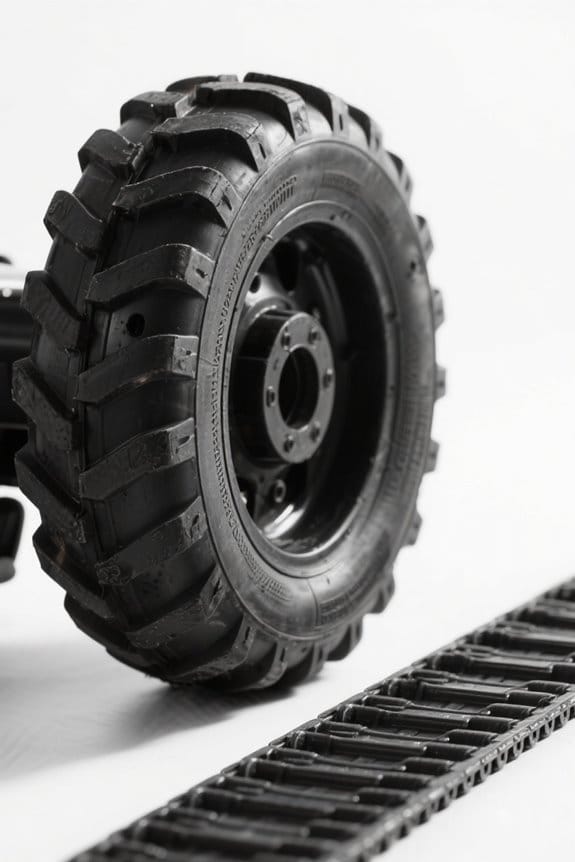
Though both wheel and track systems serve pool cleaning purposes, distinctly prioritize their operational capabilities before making a choice. Evaluate wheel-based cleaners, which use jets, offering cost-effective solutions able to handle irregular shapes but limited to inclines up to 60°. Contrast with track-based robotic cleaners, which provide superior grip and power, enabling climbs on steep inclines up to 90°, plus enhanced stability and control. Assess the pros and cons closely: track systems often include rotating brushes for deeper cleaning, reducing filter load by about 50%, while wheel systems rely on non-rotating brushes and may lack equal wall and stair coverage. Consider maneuverability requirements and surface types carefully for informed wheels vs tracks decisions, ensuring ideal pool maintenance performance tailored to specific cleaning challenges. Additionally, selecting equipment with proper safety features is crucial to prevent accidents during operation and maintenance.
Recommended Products

Conquer Complex Pools with AI Mapping: Achieve ultra-precise navigation, obstacle detection, and full coverage with AI Mapping. This pool robot cleaner maps complex layouts and lets you view routes in the app for total control. Ensure your data's safe with TÜV-Certified Privacy Protection.

5-in-1 Cleaning Power — Effortlessly clean every pool surface, waterline, walls, floor, and clarify water, using one device. Save time and effort with innovative submarine propulsion. (Includes Clarifying Agent Kit)

Unrivaled 10H Battery & 15-Day Cycle: Powered by industry-leading battery tech, enjoy up to 10 hours of continuous floor cleaning or 6 hours of full-pool deep cleaning. Maintain a spotless pool for up to 15 days on a single charge, perfect for busy homeowners.
Advantages of Track Based Pool Cleaners
Because track-based pool cleaners deliver superior grip and power, prioritize their use for pools with steep walls and challenging inclines up to 90°. Select track-based pool cleaners when deep scrubbing is necessary, as their rotating brushes remove tough dirt and algae buildup effectively. Utilize enhanced maneuverability to navigate complex pool designs and slopes, ensuring complete surface coverage. Employ these cleaners to reduce strain onpool filters, lowering filter workload by approximately 50%. Activate the track-driven system fully, maintaining traction across all surfaces, especially in heavy debris scenarios, to guarantee thorough cleaning. Monitor motion regularly, adjusting settings if the cleaner struggles with changes or debris accumulation. Consistently maintain tracks and brushes to preserve superior grip and maneuverability performance throughout the cleaning cycle. Regular inspection and maintenance of hardware components can extend the life and efficiency of these systems.
Recommended Products

Bionic AI Dual-Camera Vision with Smart Path Planning – 3D Mapping & Automated Route Optimization: Using dual AI cameras to construct a real-time 3D map of your pool, the iGarden K-AI 65 pool robot accurately identifies boundaries, obstacles, slopes, water lines, and visible debris. This visual intelligence enables the robot to understand the pool environment, automatically plan an optimized 3D S-shaped cleaning path, eliminate random movement, and deliver faster, more efficient daily coverage.

Unrivaled 12H Battery & 18-Day Cycle: Powered by industry-leading battery tech, enjoy up to 12 hours of continuous floor cleaning or 7 hours of full-pool deep cleaning. Maintain a spotless pool for up to 18 days on a single charge, perfect for busy homeowners.

[Stable Dual Tailpiece and Guide Rail Design]: The billiard cue repair machine features a dual tailpiece and guide rail design for robust stability. The 1.3-inch (33 mm) main shaft hole securely holds the cue tail, minimizing the risk of jamming during operation.
Advantages of Wheel Based Pool Cleaners
When selecting a wheel-based pool cleaner, factor in cost-effectiveness by comparing model prices and warranty coverage, focusing on options that balance affordability with durability. Prioritize lightweight designs for easy transport between storage and the pool, reducing handling effort. Choose wheel cleaners that minimize wear, ensuring longevity and cutting down on frequent pool maintenance. Evaluate how the cleaner’s movement reduces strain on the pool filter; wheel models typically halve filter usage, extending its operational life. Opt for wheel-based cleaners if your pool has irregular or bowl-shaped contours, as they typically adapt better than track models. Assess wheels vs track performance for your specific setup, aiming to enhance cleaning efficiency while managing costs and system durability effectively. Additionally, selecting models with urethane wheels with stainless steel bearings can improve movement and durability, especially on uneven pool surfaces.
Recommended Products

DIRT AND DEBRIS CANNOT HIDE: This Hayward pool vacuum cleaner has patented turbine vanes to prevent clogs and ensure maximum power at virtually any flow. Patented adjustable roller skirts maintain optimal suction on uneven surfaces

V-Flex technology eliminates clogs and maximizes power at any flow rate

Complete Internal Cleaner Assembly – All critical internal parts included: steering/mechanism, self-adjusting turbine vanes, regulator/bypass valve, vacuum lock, universal hose adapter, dual throats
Challenges Faced by Track and Wheel Cleaners
As you compare pool cleaner types, recognize that track and wheel cleaners each present distinct operational challenges requiring specific attention. For wheel-based cleaners, avoid steep slopes exceeding 60°, as wheels may slip or jam, especially on pool steps or high debris areas—pre-clean manually to reduce blockages. Track cleaners handle inclines up to 90° and rough surfaces but require routine inspection to maintain efficient grip over mole divots and uneven pool bottoms. Track cleaners demand less maintenance; however, make sure tracks remain free of debris to prevent performance loss. Both wheels or tracks reduce filter strain by about half, but act promptly on any signs of stalling or slipping. Carefully monitor the terrain, clean components regularly, and adjust use based on surface type and debris load for best results. Additionally, regular part checks and cleaning filters maintain performance efficiency ensuring both wheel and track systems operate optimally.
Selecting the Right Cleaner for Your Pool
Before selecting a pool cleaner, assess the pool’s shape, depth, and surface type to determine the best fit. Pool owners with inground pools featuring slopes and deep ends should consider track-based pool robots, which climb walls at up to 90° angles and handle heavy debris with rotating brushes. For irregularly shaped or above-ground pools, wheel-based models offer cost-effective cleaning and manage light debris efficiently, though they only climb inclines up to 60°. Evaluate cleaning needs, budget constraints, and maintenance demands; track cleaners reduce filter wear by about 50%, while wheel types require more frequent pre-cleaning to avoid jamming. Choose the type of cleaner matching pool complexity and debris load, balancing performance against cost. Avoid underestimating pool geometry and debris characteristics when determining the ideal cleaning solution. Additionally, cordless pool vacuums with auto-parking features can simplify retrieval, especially for above ground pools.
Recommended Products

Hands-Free Lawn Care for Large Properties: Set your mowing schedule once and let YARBO handle the rest. Powered by advanced autonomous navigation and intelligent route planning, YARBO robot lawn mower tackles up to 6.2 Acres (25,000㎡) with 120 minutes runtime per charge

BlueHybrid Technology – Corded & Cordless in One:Switch between cordless convenience and corded power with BUBLUE’s industry-first hybrid design! Use cordless operating mode for effortless daily cleaning or corded operating mode for deep cleaning with unlimited runtime. Plus, in corded operating mode, it cleans while charging, fully recharging in just 3 hours—ensuring your pool stays spotless without interruption!
【Pure Vision Navigation — Hands-Free Mowing, No Wire to Bury】 eufy V-FSD 1.0 uses high-precision stereo cameras and AI algorithms to see, map, and navigate your yard entirely on its own. No boundary wire to bury, no external station to set up — just place the base, open the app, and E15 handles everything automatically. Set a schedule and come home to a perfectly mowed lawn, hands-free.
Impact of Pool Design on Cleaner Performance
Evaluate the pool’s design carefully to determine which cleaner type delivers ideal performance. Assess the bottom’s flatness and debris load; wheel-based cleaners suit flat-bottomed inground pools with light debris due to efficient navigation and lower power demands. For pools featuring deep ends, slopes, or shifts between depths, choose track-based cleaners for superior grip and wall-climbing ability up to 90°. Inspect pool shape—irregular designs benefit from wheel-based cleaners capable of maneuvering corners and obstacles effectively. Consider debris type: heavy leaves and dense dirt require track-based cleaners, which maintain stability on variable surfaces. Match cleaner capabilities precisely to pool contours and debris characteristics to optimize cleaning efficiency and minimize mechanical strain. Take measurements of slopes and bottom angles, ensuring compatibility with the chosen cleaner’s specifications before purchase, avoiding performance issues or incomplete coverage. Additionally, consider the cleaner’s power ratings, as motors with higher wattage can handle tougher terrain and heavier debris more effectively.
Recommended Robotic Pool Cleaners With Wheels and Tracks
Begin by identifying robotic pool cleaners suited to your pool’s features, focusing on wheel and track systems. Choose track-based models like the Aquabot Turbo T4RC or Dolphin Oasis Z5 for pools requiring deep cleaning and wall climbing up to 90°. Expect these to reduce filter usage by about 50%, optimizing water circulation. Opt for wheel-based cleaners if budget constraints exist or if the pool is irregularly shaped, as they typically handle inclines up to 60° and offer easier transport. Evaluate your pool’s shape, incline, and debris type to determine the most effective choice. Remember, wheel-based units are generally lighter, ideal for small or above-ground pools, while track-based devices excel in robust cleaning efforts with enhanced stability on steep surfaces. Prioritize accordingly for efficient maintenance. For example, models like the Dolphin Nautilus CC Supreme feature Smart Navigation technology that enhances cleaning efficiency and coverage.
Recommended Products

True 4WD Power for Steep, Uneven Lawns: Equipped with independent hub motors, A3 AWD Pro climbs slopes up to 38.7° (80%) with exceptional traction and stability. Built to handle complex terrain, uneven ground, and challenging backyard layouts with confidence.

Scrubbing HyperBrush removes the toughest ontaiminants stuck to the pool wall + HyperGrip Rubber Tracks for superior wall climbing

For In-ground Pools: Designed for all in-ground pools, the swimming pool vacuum robot adapts to any size, shape, and style, ensuring thorough cleaning of floors, walls, steps, and waterlines.
Frequently Asked Questions
Are Wheels Better Than Tracks?
Wheels offer better cost comparison and improved maneuverability in irregular pools, but lack traction compared to tracks. Tracks provide superior grip on inclines and rough surfaces, making them less versatile but more powerful for heavy debris cleaning scenarios.
What Is the Most Reliable Robotic Pool Cleaner?
Studies show 85% of users prefer robotic pool innovations with superior cleaning performance. Among them, the Water TechniX Hydro4 HX1 leads in efficiency comparisons, combining powerful dual pumps and smart navigation for reliable, thorough pool maintenance.
What Are the Benefits of Treads Vs Wheels?
Tread efficiency surpasses wheel durability by providing superior cleaning performance on slopes and uneven surfaces, enhancing grip and maneuverability. Wheels offer robust durability but less effective cleaning on complex pool shapes compared to tread-based systems.
What Is the Lifespan of a Robotic Pool Cleaner?
The lifespan of a robotic pool cleaner typically ranges from 5 to 7 years. Cleaning efficiency depends on consistent maintenance tips, which help reduce replacement costs by prolonging durability and ensuring peak performance under various pool conditions.